Ouestions and Answers on Civil Procedure
※ All court proceedings are conducted in the Japanese language (Article 74 of the Court Act).
No. 1 Civil Litigation and Its Proceedings
1. Types of civil litigation
2. Trial proceedings of civil litigation
(1) Commencement of proceedings—filing of an action
(2) Oral arguments, etc.
- After a litigation is instituted, what kind of proceedings are followed in court?
- What kind of proceedings are conducted on the date for oral arguments?
- What kind of proceedings are conducted on the date for proceedings to arrange issues and evidence?
- What kind of proceedings are conducted on the date for examination of evidence?
- What is a record of oral arguments?
(3) Conclusion of litigation
(4) Appeal against a judgment— appeal to the court of second instance and final appeal
3. Court costs
(1) Burden of court costs
(2) Systems such as a grace period for payment
No. 2 Other Civil Cases and Their Proceedings
1. Labor tribunal proceedings
(1) Commencement of labor tribunal proceedings
- What kind of disputes are subject to labor tribunal proceedings?
- With which court should a petition for labor tribunal proceedings be filed?
- Do I have to ask an attorney to file a petition for labor tribunal proceedings?
- What kind of documents should I prepare when filing a petition for labor tribunal proceedings?
- What matters should a written petition for labor tribunal proceedings contain?
- What should I do if I become a respondent of labor tribunal proceedings?
(2) Hearing of labor tribunal proceedings
(3) Closing of labor tribunal proceedings
- In what kind of cases is a labor tribunal decision rendered? Also, what are the contents of the decision?
- What should I do if I am dissatisfied with a labor tribunal decision?
- What happens if no challenge is filed against a labor tribunal decision, and the decision becomes final and binding?
- Apart from a case where a labor tribunal decision is rendered, in what kind of cases is a labor tribunal case closed?
(4) Other procedures
2. Civil enforcement proceedings
(1) Compulsory enforcement proceedings and proceedings of auction for the exercise of a security interest
(2) Proceedings of enforcement against real property
A. Immovable property auction proceedings
- Please explain the procedure for applying for a continuation order if a petition for a compulsory auction of immovable property that has been seized based on a disposition to collect arrears imposed by the tax authorities, etc., or any other similar petition, is filed?
- Please explain the procedure for carrying out a subrogation registration when a petition is filed for an auction.
- Please explain the procedure for filing a petition for an auction based on a (revolving) mortgage that has been transferred by a partial subrogation payment.
- Please explain the procedure for submitting a written inquiry about the progress of an auction of immovable property.
- Please explain the method of avoiding rescission due to no surplus.
- Please explain the method of filing a petition for permission to pay land rent in place of the obligor.
- Please explain the procedure for withdrawing secured immovable property auction (compulsory auction) proceedings.
- Please explain the procedure for filing a proof of claims.
- How can I look for the real property I wish to purchase?
- How can I acquire information on the immovable property I wish to purchase?
- How do I make a purchase offer?
- How are the proceedings for transferring the ownership of the immovable property I have successfully bid for carried out?
- Who carries out the registration proceedings?
- Please explain the procedure for a purchaser to establish a mortgage on an auction property (applying for the issuance of a registration commission document under Article 82, paragraph (2) of the Civil Enforcement Act).
- Please explain the procedure for filing a petition for a immovable property delivery order.
- Please explain the procedure for filing a petition for the grant of a certificate of enforcement for a delivery order and applying for a Certificate of Service.
- Please explain the process of the procedures from filing a petition for a delivery order to filing a petition for judicial enforcement.
B. Proceedings of enforcement against earnings from secured immovable property
- What is the difference between the enforcement against earnings from secured immovable property and seizure of rents, etc. through proceedings of enforcement against claims (extension of security interest to proceeds of collateral)?
- What happens when immovable property is sold through auction proceedings?
(3) Proceedings of enforcement against claims
- If the other party's salary is seized, is it possible to seize the full amount?
- What should I do if a third-party obligor does not pay voluntarily?
- In what case must a third-party obligor make a statutory deposit?
- Please explain the procedure for collecting a claim, and the procedure to withdraw a petition.
- Please explain the procedure for filing a petition to change (reduce) the scope of seizure.
- Please explain what should be done if a third-party obligor has paid deposit money in error (an application for non-acceptance of a Notice of Circumstances (Certificate of Deposit)).
- Please explain what documents are required for a provisional attachment obligee to receive distribution.
- Please explain what happens if the deposit money paid by a third-party obligor remains even after the petition for an order of seizure of a claim has been withdrawn or voided.
- Please explain the method of filing an opposition to distribution.
- Please explain the procedure that follows after an action pertaining to an opposition to distribution has been terminated.
(4) Investigation procedures of obligator’s financial status
A. Asset disclosure procedures
- Please explain the requirements and documentary evidence for filing a petition for an asset disclosure procedure.
- Please explain the key points to note when preparing a petition.
- Please explain the procedure for applying for a certificate that shows the procedure on the asset disclosure date has been implemented.
B. Procedures for acquiring information from a third party
- Please explain the requirements and documentary evidence for filing a petition for the information acquisition procedure (“procedures for acquiring information from a third party”).
- Please explain who the third party is in the information acquisition procedure.
- Please explain the procedure for withdrawing a petition.
3. Insolvency proceedings
(1) Bankruptcy proceedings
- What are the differences between bankruptcy proceedings and rehabilitation proceedings for individuals?
- Will an obligor suffer any restrictions (or other disadvantages) if an order of commencement of bankruptcy proceedings is issued?
- If an order of commencement of bankruptcy proceedings is issued, what happens to the debts?
- With which court should a petition for bankruptcy proceedings and a petition for grant of discharge be filed? In addition, what is the approximate amount of costs to be paid to the court for filing a petition?
- What kind of documents should I prepare when filing a petition?
- Is a bankruptcy trustee always appointed in bankruptcy proceedings?
- I, as an obligee, received a written notice of an order of commencement of bankruptcy proceedings from a court. What should I do?
- I, as an obligee, received a written notice of bankruptcy claims. What is it?
(2) Ordinary civil rehabilitation proceedings
- What kind of procedure are ordinary rehabilitation proceeding?
- With which court should a petition for ordinary rehabilitation proceedings be filed? In addition, what is the approximate amount of costs to be paid to the court for filing a petition?
- What kind of documents should I prepare when filing a petition for ordinary rehabilitation proceedings?
- I, as a obligee, received a written notice of an order of commencement of rehabilitation proceedings from a court. What should I do?
(3) Individual rehabilitation proceedings
- What kind of procedure are rehabilitation proceedings for individuals?
- With which court should a petition for rehabilitation proceedings for individuals be filed? In addition, what is the approximate amount of costs to be paid to the court for filing a petition?
- What kind of documents should I prepare when filing a petition for rehabilitation proceedings for individuals?
- I heard that if I follow certain proceedings, I do not need to let go of my housing even if it becomes difficult to repay the housing loan. What kind of proceedings are they?
- In rehabilitation proceedings for individuals, what would be the approximate amount I would have to repay?
- I, as an obligee, received a written notice of an order of commencement of rehabilitation proceedings for individuals from a court. What should I do?
(4) Corporate reorganization proceedings and special liquidation proceedings
- (Corporate reorganization) What kind of procedure are provisional measures?
- (Corporate reorganization) If reorganization proceedings are commenced, what effects will they have?
- (Corporate reorganization) What are reorganization claims and secured reorganization claims?
- (Special liquidation) Please explain the process of special liquidation procedures.
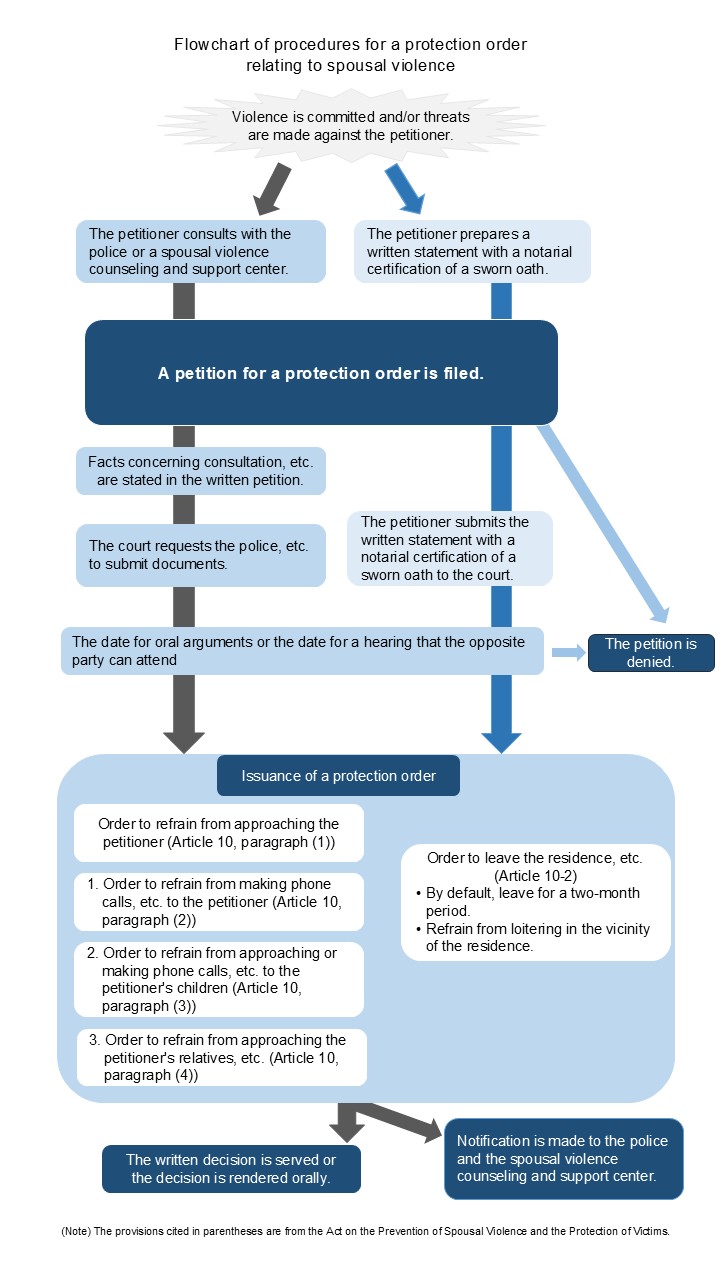
4. Procedures for a protection order relating to spousal violence, etc
- What types of litigations are there in civil cases?
- The types of civil litigation can be largely categorized as follows.
The first type is litigation for seeking resolution of a legal dispute between individuals and corporations, mainly over property rights. For example, actions seeking repayment of loans, seeking eviction of immovable property such as land or buildings, or seeking damages for an injury caused by a traffic accident are categorized into this type. This type of litigation is called "ordinary litigation," and its proceedings are held in accordance with the Code of Civil Procedure, which stipulates civil litigation proceedings.
The second type is litigation for seeking payment of money up to 600,000 yen through simple and expeditious trial proceedings. This type of litigation is called a "small claims action."
Other types include "action on bills, notes, or checks," which is litigation for seeking payment of bills, notes, and checks and its proceedings are held in accordance with the special provisions of the Code of Civil Procedure. Also, "personal status litigation," which is a trial regarding a dispute on family relationships, such as an action for divorce or acknowledgment of parentage (for details, please see "No. 2 Personal Status Litigation and Its Proceedings" in "Questions and Answers on the Proceedings of Family Related Cases"), and "administrative litigation," which is litigation for seeking the rescission of an act constituting the exercise of public authority by an administrative agency.
- How can civil litigation be instituted?
- To institute civil litigation (file an action), a plaintiff or the plaintiff's attorney (counsel) must submit a "complaint" to the court. The plaintiff needs to state in the complaint what kind of judgment the plaintiff is seeking (the object of the claim) and the facts giving rise to the claim (the statement of the claim), and pay the amount stipulated by law as the fee for instituting the trial.
- With which court should civil litigation be instituted?
- Whether the court which the civil litigation can be instituted is a district court or a summary court (subject-matter jurisdiction), and the location of the court (territorial jurisdiction) are determined in accordance with the provisions of the Courts Act, the Code of Civil Procedure, and other related laws.
- Should a litigation be instituted with a district court or a summary court?
- That depends on the value of the subject matter of a lawsuit, which is determined based on the interest that is claimed by filing the action. According to the Courts Act, a summary court is the court of first instance for a civil litigation relating to a claim for an amount of 1.4 million yen or less. Meanwhile, a district court is the court of first instance for any other general civil litigation.
- Should a litigation be instituted with a court having jurisdiction over the domicile of the plaintiff or that of the defendant?
- In principle, the plaintiff is to institute a trial with a court having jurisdiction over the defendant's domicile. However, a trial seeking damages due to tort, for example, may be instituted with the court having jurisdiction over the place where the tort took place. On the other hand, a trial relating to immovable property may also be filed with the court having jurisdiction over the location of the immovable property in question.
- After a litigation is instituted, what kind of proceedings are followed in court?
- The judge who is to take charge of the case (the presiding judge if the case is tried by multiple judges (called "a panel")) checks the complaint, and if there is no defect in formality, designates the date and time for conducting trial proceedings in a courtroom open to the public (called the "date for oral arguments"). Then, the court sends a writ of summons to order the plaintiff and the defendant to appear at the court on that date and time. If there is a defect in the complaint, the judge (the presiding judge in the case of a panel) may order the plaintiff to correct the defect (called a "correction").
- What kind of proceedings are conducted on the date for oral arguments?
- On the date for oral arguments, oral arguments are held in a courtroom open to the public by one judge in the case of a summary court, or one judge or a panel of three judges in the case of a district court. In the case of a high court, in principle there is a panel of three judges. In the case of a district court, a case may be tried by one judge unless otherwise provided by law. However, a case of appeal against a judicial decision rendered by a summary court must be tried by a panel, and a case that has been decided to be tried by a panel due to its complexity or difficulty is also tried by a panel.
On the date for oral arguments, proceedings are conducted under the direction of the presiding judge. The plaintiff and the defendant, or their attorneys (or other counsel) do the following: appear at court (or may appear by web conferencing if the court deems appropriate); make allegations based on the complaints, written answers (i.e., the defendant's written response to the plaintiff's claims or allegations stated in the complaints), and briefs (which are documents containing the party's allegations and responses to the adverse party's allegations) that they have submitted to the court in advance; and submit evidence and other materials in support of their allegations. If the defendant is absent, a judgment may be rendered in favor of the plaintiff's claim unless the defendant has clarified his/her intention to dispute the plaintiff's claim in a written answer or any other documents.
If the presiding judge finds any contradictions or ambiguities in a party's allegations or evidence, he/she may ask questions to the party or require the party to clarify the ambiguities (called "the court's authority to ask for explanation").
- What kind of proceedings are conducted on the date for proceedings to arrange issues and evidence?
- In a case where facts necessary to make a decision are disputed between the parties, and there is a need to arrange issues and evidence, the court may conduct proceedings to arrange issues and evidence in order to prepare to conduct the examination of evidence, including examination of witnesses, efficiently and intensively by narrowing down the points at dispute (i.e. the issues).
There are three types of proceedings to arrange issues and evidence, namely (i) preliminary oral arguments, (ii) preparatory proceedings, and (iii) preparatory proceedings by means of documents, and the court selects the most appropriate proceedings in accordance with the nature and details of the case. The preliminary oral arguments are held in a courtroom open to the public, and they are characterized in that all manner of acts necessary for arranging issues and evidence can be conducted. The preparatory proceedings do not need to be open to the public, and are normally held in a room other than a courtroom, such as an argument preparation room. There are certain restrictions, however. These may include not being able to examine witnesses for arranging issues and evidence. Nonetheless, it is possible to conduct the proceedings by web conferencing or other methods when a party resides far away from the court, for example. The preparatory proceedings by means of documents are conducted to arrange issues and evidence by allowing the parties to submit briefs, etc. If necessary, web conferencing or other methods may be used.
When closing these proceedings, the court and the parties are to confirm the facts to be proven through the subsequent examination of evidence.
- What kind of proceedings are conducted on the date for examination of evidence?
- After the issues between the plaintiff and the defendant are clarified through the oral arguments or proceedings to arrange issues and evidence, in order to make a determination on these issues, the court conducts examination of evidence, which includes examination of documentary evidence, witnesses, and the parties. In examination of a witness, in principle, the party who requested the examination examines the witness first, after which the other party examines the witness. The court normally examines the witness after the parties have completed the examination. However, the presiding judge may ask questions to the witness whenever he/she considers it to be necessary. The Code of Civil Procedure and the Rules of Civil Procedure stipulate several rules for examination of witnesses, such as the order in which the witnesses, etc. are examined and the restrictions on leading questions. Whether or not to examine offered evidence is under discretion of the court, but the court basically cannot conduct examination of evidence without a request by the plaintiff or the defendant. An exception to this rule is the examination of the parties, which the court may conduct based on its own discretion.
In the fact-finding process—a process in which the existence or nonexistence of the disputed facts is found based on the results of the examination of evidence—the probative value is evaluated at the discretion of the court.
- What is a record of oral arguments?
- A record of oral argument is a record that contains the allegations made by the parties or the statements made by witnesses in the courtroom and is prepared by the court clerk who was present in the courtroom. The record contains the statements made by the witnesses, experts, and parties in the courtroom, as well as information on allegations and the submission of evidence by the parties.
- How is a litigation closed?
- Litigation proceedings, which were commenced by submission of a complaint, are closed based on various grounds. The most typical ground for the closing of the proceedings is rendering of a judgment.
- In what kind of cases is a judgment rendered?
- If the court considers that the plaintiff's claims should be upheld or denied, the court concludes the oral arguments and renders a judgment. The judgment is rendered in the courtroom open to the public based on a judgment document, in principle. A judgment document, which contains the main text of the judgment, the parties' allegations, and the grounds for the determination, among other matters, is promptly served on both parties after the judgment is rendered. However, for a case where there is no dispute in effect, such as where the defendant does not dispute the facts alleged by the plaintiff, a judgment may be rendered in a simple manner without being based on the original judgment document. In this case, the court clerk will prepare a record stating the main text of the judgment, etc. in lieu of the preparation of a judgment document.
When a judgment has been rendered, compulsory enforcement cannot be carried out based on the judgment until the period for filing an appeal against the judgment has passed (until the judgment becomes final and binding). An exception to the above is in a case where the court declares that a provisional enforcement may be effected.
- In what cases other than rendering of a judgment is litigation closed?
- Trial proceedings are also closed due to withdrawal of the action or a judicial settlement. A judicial settlement has the same effect as a judgment that has become final and binding.
- What kind of proceedings can a party follow when dissatisfied with a judgment?
- A party who is dissatisfied with the judgment rendered by the court of first instance may file an appeal with an upper instance court within two weeks from the day on which the judgment is served, and a party who is dissatisfied with a judgment rendered by the court of second instance (appellate instance) may file a final appeal.
In other words, against a judgment rendered by the district court in the first instance, an appeal may be filed with a high court, and against a judgment rendered by the high court in the second instance, a final appeal may be filed with the Supreme Court.
Against a judgment rendered by a summary court in the first instance, an appeal may be filed with a district court, and against a judgment rendered by a district court in the second instance, a final appeal may be filed with a high court. Against a judgment rendered by a high court in the third instance, an appeal may be filed with the Supreme Court as an exception, if it involves a constitutional issue. This appeal is called a "special appeal to the court of last resort."
- Who bears the cost of civil litigation?
- The court costs stipulated by law are basically borne by the party defeated in the trial. The court costs include fees for filing a case, fees for filing a petition, and travel expenses and daily allowances, etc. for witnesses. The court costs in this case do not include all expenses necessary for conducting a trial; for example, they do not include attorneys' fees.
- What kind of systems, such as a grace period for payment, are available for parties that lack financial resources?
- Available systems include "legal aid" and the "lending system under Civil Legal Aid."
- What is "legal aid"?
- It is a system that provides a grace period for the payment of court costs in order to guarantee the right of access to the courts even for people who lack the financial resources to pay court costs. However, the grace period is only offered if it cannot be said that there is no probability of winning the trial based on the details of the petition.
- What is the "lending system under Civil Legal Aid"?
- It is a system implemented by the Japan Legal Support Center. When people who lack financial resources need to retain attorneys, etc. in order to resolve their problems, the Japan Legal Support Center pays attorneys' fees, etc. For them after examining their financial resources and the probability of winning the case (or resolving the problem)?
- What kind of disputes are subject to labor tribunal proceedings?
- The disputes subject to labor tribunal proceedings are those concerning civil affairs arising between an individual employee and an employer about matters in connection to labor relations (a civil dispute arising from individual labor relations), such as a case where an employee is dismissed by a company or has not been paid due salary by a company.
Therefore, a so-called collective labor-management dispute arising between a labor union and an employer or a dispute subject to administrative case litigation, such as a dispute in which a public employee seeks rescission of a disciplinary action, is not subject to labor tribunal proceedings.
Meanwhile, labor tribunal proceedings are a procedure for achieving resolution of a dispute whereby the proceedings are concluded by the end of the third date for proceedings, in principle. Therefore, it is considered to be inappropriate to use labor tribunal proceedings for a dispute which is expected to be difficult to resolve by the end of the third date for proceedings, such as a dispute concerning discrimination or a dispute concerning adverse alteration of rules of employment.
- With which court should a petition for labor tribunal proceedings be filed?
- A petition for labor tribunal proceedings is to be filed with the district court having jurisdiction over the location of the domicile, business office, or any other office of the respondent, the district court having jurisdiction over the location of the employer's place of business at which the employee works (or has worked most recently), or a district court determined by an agreement between the parties.
In addition to the main office of each district court, the Tachikawa Branch of the Tokyo District Court, the Hamamatsu Branch of the Shizuoka District Court, the Matsumoto Branch of the Nagano District Court, the Fukuyama Branch of the Hiroshima District Court, and the Kokura Branch of the Fukuoka District Court also handle labor tribunal cases.
- Do I have to ask an attorney to file a petition for labor tribunal proceedings?
- You may file a petition for labor tribunal proceedings yourself, without asking an attorney to do so.
Indeed, as labor tribunal proceedings are aimed at resolving a dispute in accordance with the circumstances of the case while taking into account the rights and interests between the parties, and are to be concluded by the end of the third date for proceedings, in principle, it is important to make sufficient preparations from the stage of filing a petition, and submit an adequate written petition and necessary evidence. In addition, because the parties mutually state their arguments orally on the date for proceedings, in principle, the petitioner should examine the written answer and evidence submitted by the respondent in detail, and should make precise allegations (arguments) and submit evidence on the date for proceedings.
Whether to retain an attorney is ultimately your decision, but in order to make sufficient preparations from the stage of filing a petition, and to present precise allegations and evidence according to circumstances on the date for proceedings as mentioned above, it would be desirable to retain an attorney, who is a law expert, as needed.
- What kind of documents should I prepare when filing a petition for labor tribunal proceedings?
- When filing a petition for labor tribunal proceedings, you need to prepare the following documents.
1. Written petition
2. Fee for filing a petition (revenue stamps) and postage stamps
3. If the respondent is a corporation, a transcript of the commercial register or a certificate of registered information, etc.
4. Basic documents that clarify the details of the employment relationship and documentary evidence of expected issues
For example:
- A document that shows the employment relationship, the amount of wage, or the amount of retirement allowance
→ An employment agreement, rules of employment (rules on wage or retirement allowance rules), salary statement, withholding certificate, job advertisement, etc.
- A document that shows the hours worked or the fact of retirement
→ An attendance book, time card, or retirement certificate, etc.
- A document that shows the time of and the reason for dismissal
→ A dismissal notice, statement of the reason for dismissal, etc.
* As the amounts of the fee for filing a petition, postage stamps, etc. differ depending on the contents of the petition, please inquire with the district court with which you will file the petition.
In addition to the main office of each district court, the Tachikawa Branch of the Tokyo District Court, the Hamamatsu Branch of the Shizuoka District Court, the Matsumoto Branch of the Nagano District Court, the Fukuyama Branch of the Hiroshima District Court, and the Kokura Branch of the Fukuoka District Court also handle labor tribunal cases.
* When submitting a written petition, you need to attach one copy of the written petition for each respondent plus three, and when submitting a copy of documentary evidence, you need to attach one copy for each respondent.
- What matters should a written petition for labor tribunal proceedings contain?
- A written petition for labor tribunal proceedings needs to contain the names of the parties (the petitioner and the respondent) (if a party is a company, also the name of its representative), their addresses and telephone numbers, as well as the following matters, and the petitioner or an agent thereof must affix his/her name and seal to it.
1. Object of the petition
2. Reasons for the petition
3. Expected issues and material facts concerning the issues
4. Evidence of each expected issue
5. Outline of the background to the petition, such as the negotiations conducted between the parties (including those conducted in the course of mediation or other procedures)
- What should I do if I become a respondent of labor tribunal proceedings?
- If you become a respondent of labor tribunal proceedings, the court will send you a writ of summons for the date for proceedings, along with documents such as a request for a written answer, a copy of the written petition for labor tribunal proceedings, and a copy of documentary evidence. A respondent needs to read and examine those documents carefully, and by the specified date, submit documents including a written answer containing counterarguments against the written petition and the outline of the background of the petition, such as the negotiations conducted between the parties, and a copy of documentary evidence to the court, and also send a copy of each of those documents to the petitioner.
As labor tribunal proceedings are concluded by the end of the third date for proceedings, in principle, the respondent needs to submit his/her arguments and evidence at an early stage. In particular, the written answer is an important document for informing the labor tribunal hearing the case of the respondent's arguments against the written petition. In order to make preparations, such as preparing an adequate written answer and submitting necessary documentary evidence, within a short period of time and to present precise allegations and evidence on the date for proceedings, it would be desirable to retain an attorney, who is a law expert, as needed.
When retaining an attorney, it is important to consult the attorney as promptly as possible after receiving a written petition.
- What is the composition of a labor tribunal hearing a case?
- A labor tribunal is composed of one labor tribunal judge (a judge) and two labor tribunal members who have expert knowledge and experience in labor relations.
The labor tribunal members are appointed from among persons who have an experience of actually engaging in processing of labor disputes from the standpoint of an employee or an employer (for example, an officer of a labor union or a person in charge of personnel labor affairs in an enterprise), and who have acquired knowledge on the actual state, practices, systems, etc. of labor relations during that course of experience. However, even if a labor tribunal member has an experience either as an employer or employee, he/she will not side with either of the parties, but will participate in the proceedings and determinations only from a neutral and fair standpoint.
- What kind of proceedings are conducted on the date for labor tribunal proceedings?
- A labor tribunal hears both parties' arguments on facts and legal points, arranges the points at issue, and conducts necessary examination of evidence.
Meanwhile, labor tribunal proceedings are not open to the public, but the labor tribunal may permit observation by a person whom it considers to be appropriate.
- In labor tribunal proceedings, how is a case resolved through discussions (conciliation)?
- While a labor tribunal conducts proceedings on the rights and interests between the parties with regard to the dispute relating to the petition on the date for labor tribunal proceedings, if the case is likely to be resolved through discussions between the parties, the labor tribunal attempts conciliation at any time. If the parties reach an agreement, the dispute may be resolved amicably through conciliation.
If a case cannot be resolved through conciliation, the labor tribunal renders a labor tribunal decision.
- In what kind of cases is a labor tribunal decision rendered? Also, what are the contents of the decision?
- If a labor tribunal hears a case on the date for labor tribunal proceedings, but the case cannot be resolved through conciliation, the labor tribunal renders a labor tribunal decision, which is necessary for resolving the case in accordance with the actual conditions of the case while taking into account the rights and interests between the parties that were found as a result of the proceedings and various circumstances that arose in the course of the procedure.
In a labor tribunal decision, it is possible to achieve flexible and coordinated resolution of the case while utilizing the expert knowledge of the labor tribunal members. For example, even if the labor tribunal determines as a result of proceedings that a dismissal by an employer is invalid, in some cases it may render a labor tribunal decision to the effect that the employer is to terminate the labor contract with the employee while paying the employee a reasonable amount of settlement money.
- What should I do if I am dissatisfied with a labor tribunal decision?
- A party that is dissatisfied with a labor tribunal decision may file a challenge with the court against the decision within two weeks from the day following the day on which the party received the written tribunal decision or the day on which the labor tribunal decision was announced. This challenge is filed by way of submitting a written challenge to the court.
When a lawful challenge has been filed, the labor tribunal decision ceases to be valid. In this case, the labor tribunal case shifts to litigation, and an action is deemed to have been filed at the time that the petition for labor tribunal proceedings was filed.
- What happens if no challenge is filed against a labor tribunal decision, and the decision becomes final and binding?
- If neither party files a lawful challenge against a labor tribunal decision, the decision becomes final and binding, and gains the same effect as a judicial settlement.
Therefore, if, for example, a labor tribunal decision ordering the respondent to pay money to the petitioner becomes final and binding, the respondent must pay the ordered amount of money. If the respondent fails to pay the money voluntarily, the petitioner may follow the procedure of compulsory execution.
- Apart from a case where a labor tribunal decision is rendered, in what kind of cases is a labor tribunal case closed?
- A labor tribunal case is closed not only by the rendering of a labor tribunal decision, but also by the establishment of conciliation and withdrawal of the petition for labor tribunal proceedings, among others.
In addition, if the labor tribunal determines that it is not appropriate to conduct the labor tribunal proceedings, such as the case being complicated, it may close the labor tribunal case. In this case, the labor tribunal case shifts to litigation, as in the case where a challenge is filed against a labor tribunal decision.
- What procedures, other than labor tribunal proceedings, are available to resolve an individual labor dispute?
- Various procedures are available, including court procedures, such as civil litigation, small claims action, and civil conciliation, and procedures by non-court organizations, such as mediation conducted by a dispute coordinating committee established in a Prefectural Labor Bureau. If the proceedings for the case are unlikely to be concluded by the end of the third date for proceedings, it may be better to file litigation from the start, and if you want to have your arguments heard in detail in the presence of a third party, civil conciliation could also be used. In addition, if you are only seeking payment of money in an amount not more than 600,000 yen, you can use a small claims action for which the trial is completed within a day, in principle. For information on the respective court proceedings, please refer to the following leaflet and information on the respective procedures provided on this website.
It is important to consider the optimal procedure to use by taking into consideration the characteristics of the respective procedures.
- What is a title of obligation?
- [* The procedures described below are an example of procedures in some courts, and certain courts may have procedures that differ from those described below.]
A title of obligation is an official document indicating the existence, scope, obligee, and obligor of a claim that is planned to be realized by judicial enforcement. This title of obligation is required for carrying out judicial enforcement. Examples of titles of obligation include the following.
a. A final and binding judgment
This is a judgment that orders, for example, "pay one million yen" or "evict the XX building," which no longer has room to be revoked by an upper instance court.
b. A judgment with a declaration of provisional enforcement
A judgment on performance attaching a declaration of provisional enforcement (the text of the judgment is, for example, "this judgment may be provisionally enforced") may be enforced before becoming final and binding.
c. A demand for payment with a declaration of provisional enforcement
d. A record of settlement or a record of civil mediation
e. A record of conciliation for a domestic relations case or a record of adjudication for a domestic relations case
f. A notarial instrument
- What kind of preparation is needed to file a petition for judicial enforcement?
- [* The procedures described below are an example of procedures in some courts, and certain courts may have procedures that differ from those described below.]
In the case of filing a petition for judicial enforcement proceedings, you should obtain from the court that rendered a judgment in your favor, etc., a certificate that the judgment, etc. has been served on the other party (a certificate of service), and have a certificate of enforcement granted for that judgment, etc. However, there are also judgments, etc., such as a demand for payment with a declaration of provisional enforcement or a judgment of a small claim action, that do not require the grant of a certificate of enforcement.
Next, you should investigate what kind of property the other party holds. Even if you file a petition for judicial enforcement, unless the other party holds the target property, the enforcement will be unsuccessful. In addition, depending on the target property, there are differences in whether there is a need to make payment to the court by means of revenue stamps or postal stamps or as procedural costs, as well as in their amounts. The court calls such costs a ‘prepaid expense’. For example, in order to carry out the seizure of immovable property, a large deposit is required in advance and sometimes the petitioner cannot receive any distribution for his/her claim due to mortgages or other prioritized creditors. Therefore, it is important to choose the property to be seized that corresponds to the amount claimed. If certain conditions are met, a petition for a asset disclosure procedure (a procedure to have the opposite party declare the existence or nonexistence, location, etc. of the party's asset) or an information acquisition procedure (a procedure to have third parties provide information about the obligor's bank deposits or immovable property) may be filed. Such conditions include when the petitioner is unable to receive full payment by implementing judicial enforcement against known property.
For information or materials required for filing a petition, please see the relevant procedure pages here (in Japanese). If you have any questions, please inquire with the court with which you will file the petition.
- Please explain the procedure for applying for a continuation order if a petition for a compulsory auction of immovable property that has been seized based on a disposition to collect arrears imposed by the tax authorities, etc., or any other similar petition, is filed?
-
[* The procedures described below are an example of procedures in some courts, and certain courts may have procedures that differ from those described below.]
Immovable property that has been seized and registered based on a disposition to collect arrears imposed by the tax authorities, etc. may be seized in a compulsory auction or an auction carried out as a means of enforcing a security interest (hereinafter collectively referred to as an "auction"). In such cases, an order to continue the auction is required to have the auction proceedings progress. Therefore, an application for a continuation order must be made.
This application must be made when a petition for an auction is filed.Application for Continuation Order (Word: 18 KB) (in Japanese)
Key points to note when completing an application form
1. If an auction is carried out as a means of enforcing a security interest, please state that it is a "secured immovable property auction."
The case code for a secured immovable property auction is (Ke).
2. You will be provided with your case number at the counter, where you should write it on your application form.
You do not need to write the case number on the application form if you send the form together with an auction petition form by postal mail or by any other similar method.
3. Please indicate the name of the government agency that carried out the seizure based on a disposition to collect arrears.
- Please explain the procedure for carrying out a subrogation registration when a petition is filed for an auction.
-
[* The procedures described below are an example of procedures in some courts, and certain courts may have procedures that differ from those described below.]
1. Documents required when filing a petition for an auction
In addition to the supporting documents required for a standard petition, the following documents are also required:* The required documents may vary depending on the court. Before filing a petition, please inquire with the court with which you will file the petition.
* It is not necessary to submit two copies of a Certificate of All Matters issued before the subrogation registration, which is to be submitted at the time of filing a petition.A. Inheritance relationship diagram (four copies)
B. Family registers, which are required to confirm the heirs, or any other similar documents (one original and one copy of each document)
* In addition to the deceased's family register showing the information from birth to death or a closed family register, the heirs' current family registers are also required.
C. Each heir's Residence Record or supplementary family register (one original and one copy of each document)
* These documents must have been issued within three months from the filing date.
D. Certificate issued by a family court regarding whether a declaration of renunciation of inheritance exists
E. Application for Certificate of Receipt of Auction Petition (one copy for application purposes and one copy for certification purposes) (Word: 21 KB) (in Japanese)
* Please make sure to attach the inventory of parties and a property that are referenced in the main body of the application form.
F. Statement of Intention to Carry Out Subrogation Inheritance Registration (one copy) (Word: 15 KB) (in Japanese)
* Please make sure to attach the inventory of parties and a property that are referenced in the main body of the application form.
G. Prepaid envelope, such as a 'Letter Pack,' with the obligees' addresses written on them (*To be used to return the Certificate of Receipt of Auction Petition, family registers, etc.)2. Procedural process
A. Prepare a petition with the heirs listed as the owners and file the petition for an auction.
B. Upon examining the petitioning obligee's petition, the court issues a Certificate of Receipt of Auction Petition based on the petition. The original family registers and other similar documents will be retained by the court to confirm the heirs.
C. As the petitioning obligee, carry out a subrogation inheritance registration at a Legal Affairs Bureau.
* The following documents are required at a minimum, but please check with the Legal Affairs Bureau in advance.
a. Inheritance relationship diagram
b. Family registers, which are required to confirm the heirs, or any other similar documents (to be retained by the court)
c. Certificate of Receipt of Auction Petition
D. After the inheritance registration is completed, submit a Certificate of All Matters (one original and two copies), copies of family registers and other similar documents which are retained by the court, and a copy of the registration application form used for the subrogation registration. The subsequent steps of this procedure are the same as those of the standard procedure.
- Please explain the procedure for filing a petition for an auction based on a (revolving) mortgage that has been transferred by a partial subrogation payment.
-
[* The procedures described below are an example of procedures in some courts, and certain courts may have procedures that differ from those described below.]
1. Petition for an auction based on a (revolving) mortgage that has been transferred by a partial subrogation payment
If you, as a subrogee who has made a partial subrogation payment (called a "partial subrogee"), file a petition for an auction, you must state in the main body of the petition that the consent of the original (or revolving) mortgagee has been obtained and attach a Letter of Consent shown in 2. below. You do not need to attach a Letter of Consent if you and the original (or revolving) mortgagee jointly file a petition for an auction or the original (or revolving) mortgagee alone files a petition for an auction.
Example of a statement that confirms the consent has been obtained:
"The petitioning obligee has acquired part of the revolving mortgage held by __________ Co., Ltd. by making a subrogation payment and has obtained the consent of __________ Co., Ltd. for this petition for an auction."2. Documents required for issuing a commencement order, etc.
In addition to the supporting documents required for filing a standard petition, the following documents are also required if a petition for an auction is filed by a partial subrogee:(1) Letter of Consent (Word: 18 KB) (in Japanese)
* Please make sure to attach the inventory of property that is referenced in the main body of the petition.
* A seal registration certificate of the person who has prepared the Letter of Consent (the original (or revolving) mortgagee) needs to be submitted as an attachment to the Letter of Consent.(2) One of the following documents that show the partial transfer of the (revolving) mortgage:
・A Certificate of Registered Information on Immovable property that shows the supplemental registration of the transfer of the (revolving) mortgage by a partial subrogation payment; or
・A notarial instrument or any other official document that shows the partial transfer of the (revolving) mortgage
However, only the above-mentioned Certificate of Registered Information on Immovable property is acceptable if the following two points are true. (1) A petition for an auction is filed by a partial subrogee who has made a partial payment for a claim that accrued before March 31, 2020, and has received the partial transfer of the (revolving) mortgage securing such claim. (2) There is a registered third-party acquirer of the subject property.
- Please explain the procedure for submitting a written inquiry about the progress of an auction of immovable property.
-
[* The procedures described below are an example of procedures in some courts, and certain courts may have procedures that differ from those described below.]
* The required documents may vary depending on the court. Before filing a petition, please inquire with the court with which you will file the petition.
1. On-site survey report
If you have carried out an on-site survey of the property at the time of establishing a mortgage or nearer the time of filing the petition, wherever possible, submit the report of that survey.
If you have investigated the actual address of the obligor or owner, wherever possible, submit the report of that investigation.2. Land survey map
The auction proceedings may be canceled if it is impossible to identify the land that is the subject property of the auction. To avoid this situation, submit a land survey map, if any (a copy is acceptable).3. If land is the only subject property of the auction:
If land is the only subject property of the auction, and there is a building on that land (which is not the subject of the property), wherever possible, submit materials that show the structure and owner of the building, the right to use the land, and any other similar information (such as photographs of the building).4. If a building is the only subject property of the auction:
Submit materials that show the details of the building's right to use land and any other similar information (such as a land use agreement), if any. If the building is a leasehold building, and there are land rent arrears, consider whether to file a petition for permission to pay land rent in place of the obligor.5. If the property is occupied by a corporation which is not the owner or the obligor:
Submit a Certificate of Registered Information of the corporation occupying the property, if any.6. Land pollution
Submit survey data on the presence or absence of land pollution or any other similar data, if any.7. Application for continuation
If the property has already been seized by a government agency that imposed a disposition to collect arrears, an application for continuation needs to be made to continue the case.
* For an application for continuation, please see Q: Please explain the procedure for applying for a continuation order if a petition for a compulsory auction of immovable property that has been seized based on a disposition to collect arrears imposed by the tax authorities, etc., or any other similar petition is filed?8. Submit any other materials that may be useful in order that the case may progress smoothly, if any.
* Submit three copies of the materials listed in 1 to 6 above (photocopies acceptable).
- Please explain the method of avoiding rescission due to no surplus.
-
[* The procedures described below are an example of procedures in some courts, and certain courts may have procedures that differ from those described below.]
The following cases are referred to as being ones in which "there is no surplus."
1. In cases where there is no claim that takes preference over the claim of the attaching obligee (hereinafter referred to as a "preferential claim"), the minimum purchase price of the immovable property does not exceed the estimated amount of the part of the enforcement costs that constitutes administrative expenses (hereinafter referred to as "procedural expenses") or
2. In cases where there is a preferential claim, the minimum purchase price of the immovable property is below the total of the estimated amount of the procedural expenses and that of the preferential claim.If the court determines that there is no surplus, the court will notify the attaching obligee to that effect. The auction proceedings will then be rescinded unless the attaching obligee, who has received the notification, takes any of the actions described in (1) to (3) below within one week from the receipt of the notification (Article 63, paragraph (2) of the Civil Enforcement Act).
If the attaching obligee is unable to take any of the actions within one week, he or she can submit a statement explaining the reason therefor and the time needed to take any of the actions. The timeframe before the auction proceedings will then be rescinded may be extended, depending on the content of the statement.
The above notification includes the estimated amount of the preferential claim and any other expenses, but does not include any specific information, such as the preferential claim holder and the breakdown of the claim. If you would like to know more, please inspect the relevant records or any other similar documents.(1) Provision of a guarantee
(A) Cases where the attaching obligee is able to purchase the immovable property (Article 63, paragraph (2), item (i) of the Civil Enforcement Act)
A method by which the attaching obligee voluntarily decides a price that exceeds the estimated amount of the preferential claim and any other claims indicated in the above notification (the obligee's offered price) as specified below, makes an offer in which the attaching obligee will purchase the immovable property at the obligee's offered price if there is no purchase offer that reaches the obligee's offered price, and provides a guarantee equivalent to the obligee's offered price (Article 63, paragraph (2), item (i) of the Civil Enforcement Act).(a) If there is no preferential claim, a price that exceeds the estimated amount of procedural expenses will be the obligee's offered price.
Purchase Offer of Immovable Property (if there is no preferential claim (procedural expenses only)) (PDF: 919 KB) (in Japanese)(b) If there is a preferential claim, a price that is not less than the total of the estimated amount of procedural expenses and that of the preferential claim will be the obligee's offered price.
Purchase Offer of Immovable Property (if there is a preferential claim) (PDF: 939 KB) (in Japanese)If the attaching obligee is unable to purchase the immovable property, the method described in (B) below applies.
The guarantee must be provided in the form of money, securities that are found to be reasonable by the enforcement court, or a contract for consignment of payment guarantee (Article 32, paragraph (1) of the Rules of Civil Enforcement).(B) Cases where the attaching obligee is unable to purchase the immovable property (Article 63, paragraph (2), item (ii) of the Civil Enforcement Act)
A method by which the attaching obligee makes an offer that the attaching obligee will pay any difference between the obligee's offered price and the purchase offer price if the purchase offer price fails to reach the obligee's offered price, and provisions of a guarantee equivalent to the difference between the obligee's offered price and the minimum purchase price.
For example, this method can be applied if the subject property is farmland with purchasing qualifications. In this case, the auction proceedings will be rescinded if there is no purchase offer that reaches the minimum purchase price. (Article 63, paragraph (3) of the Civil Enforcement Act)(2) A method of proving that a surplus is expected (First sentence of the proviso in Article 63, paragraph (2) of the Civil Enforcement Act)
A possible method is, for example, to prove that surplus is expected because a secured claim that ranks above the claim of the attaching obligee has already been extinguished by payment or by any other means.
Notification of Expected Surplus (if there is no preferential claim (procedural expenses only)) (PDF: 910 KB) (in Japanese)
Notification of Expected Surplus (if there is a preferential claim) (PDF: 1003 KB) (in Japanese)(3) Method of proving the preferential claim holder's consent has been obtained (Second sentence of the proviso in Article 63, paragraph (2) of the Civil Enforcement Act)
Evidence for the Preferential Claim Holder's Consent as Specified in the Proviso of Article 63, Paragraph (2) of the Civil Enforcement Act) (PDF: 874 KB) (in Japanese)Letter of Consent (PDF: 852 KB) (in Japanese)
The consent of a preferential claim holder who is able to receive full performance of his/her claim at the minimum purchase price is not required.
If there are any preferential public claims, it is necessary to obtain proof that not only the relevant public authority, but also all public authorities demanding the delivery of payment have given consent.
- Please explain the method of filing a petition for permission to pay land rent in place of the obligor.
-
[* The procedures described below are an example of procedures in some courts, and certain courts may have procedures that differ from those described below.]
1. Petitioner
Only attaching obligees are permitted to file a petition for permission to pay land rent in place of the obligor (Article 56, paragraph (1) of the Civil Enforcement Act).
Such obligees include attaching obligees to whom an overlapped commencement order has been issued before the time limit for a demand for distribution, but do not include mortgagees who are not obligees demanding distribution or attaching obligees.2. Timing of filing a petition
A petition must be filed after a petition for an auction is filed and before the fee is paid.3. Petition filing fee
Revenue stamps of 500 yen (Please do not affix your seal on revenue stamps.)4. Method of filing a petition
Please refer to the following document and state the object and reason for your petition on a petition form, and submit the form.Petition for Permission to Pay Land Rent in Place of Obligor (PDF: 51 KB) (in Japanese)
(1) Object of the petition
State that the attaching obligee seeks permission to pay in place of the leaseholder the land rent and other expenses of the seized building, and specify from when the attaching obligee will make the payment and how much (per month).(2) Reason for filing the petition
Describe the contents of the land lease agreement and state that the owner of the building has not paid the land rent and that there is a need to pay the land rent in place of the building owner.(3) Attachments (example)
(a) A copy of the land lease agreement
(b) A certificate issued by the landlord that shows the non-payment of the land rent
(c) A survey report issued by the attaching obligee or any other similar reports (which should be attached if the landlord and/or the leaseholder will not cooperate in submitting the documents listed in (a) and (b) above)* In addition to the above documents, the following documents are also required if the landlord has died and the registration of the transfer of ownership of the subject land by inheritance has not been completed.
・If a division of inheritance agreement has been reached as to the inheritance of the land:
A document showing the agreement and a document showing the inheritance relationship, such as the family register
・If a division of inheritance agreement has not been reached:
A document specified in (b) above that has been issued in the name of all legal heirs and a document showing the inheritance relationship, such as the family register
- Please explain the procedure for withdrawing secured immovable property auction (compulsory auction) proceedings.
-
[* The procedures described below are an example of procedures in some courts, and certain courts may have procedures that differ from those described below.]
1. Forms
Letter of Withdrawal (secured immovable property auction) (Word: 18 KB) (in Japanese)
Letter of Withdrawal (compulsory auction) (Word: 18 KB) (in Japanese)
2. Documents required to withdraw auction proceedings(1) Letter of Withdrawal: One copy
Use the same seal that you used when you filed the petition. (Alternatively, you may attach a seal registration certificate for your seal and prepare a Letter of Withdrawal using the registered seal.)
Indicate in the Letter of Withdrawal (*Please see the form templates above.), the case number, the parties (names only), the property (please state "Immovable property listed in the attached inventory of property" and attach the same inventory of property as the one used for the commencement order), and state that the proceedings will be withdrawn. Please also state the address and name of the obligee (if the obligee is a corporation, its head office, company name, corporate representative, and any other similar information).(2) Revenue stamps (for commissioning the registration): Generally, 1,000 yen per property
If the property includes the right of site, it should also be counted as a property.
Revenue stamps are used for commissioning the registration. Do not affix stamps to anything when you provide them.(3) Other
The most recent Certificate of Registered Information of the property which will be withdrawn may be required, if the property has been subdivided after the seizure. The most recent Certificate of Qualification or Certificate of Registered Commercial Information of the petitioning obligee may be required if there are any changes to the corporate representative, company name, or any other matters.
The relevant parties' consent to the withdrawal may be required. (If the claim of the attaching obligee has been partially transferred, the consent of the transferee is required. To withdraw the proceedings after the bid opening, the consent of the highest purchase offeror is required.)
It takes some time to refund the deposit after the withdrawal. For more information about refund procedures, please inquire with the court with which you will file the petition.
- Please explain the procedure for filing a proof of claims.
-
[* The procedures described below are an example of procedures in some courts, and certain courts may have procedures that differ from those described below.]
1. Form
Proof of Claim Form (Excel: 13 KB) (in Japanese)2. Key points to note about filing a proof of claims
(1) Even if your claim has been extinguished by payment or by any other means, you must make a notification accordingly.
(2) When you file a proof of claims, you must do so in the name of a person who has the legal authority. (A notification made in the name of a branch manager or sales office manager is not deemed as a valid notification.)
If a person who has no legal authority makes a notification as a representative, an Application for Authorization of Representative is required.
(3) If you fail to file a proof of claims, you may not be able to receive distribution of the proceeds of the sale or delivery of payment money.
(4) If you have made a provisional registration of the transfer of ownership and a mortgage registration to secure the same claim, list both registrations in the 'Description of registration' box and state 'Both.'
(5) For a provisional seizure, attach a copy of the provisional seizure order. If you need more space to describe your claim in the Proof of Claim Form, use an appropriate piece of paper and write the claim horizontally as opposed to vertically, as is traditional in Japanese.
(6) If there are any changes to the principal amount of the claim after filing a proof of claims, promptly make a notification of the revised amount of the claim.
(7) If you fail to file a proof of claims intentionally or negligently or make a false notification, you may be held liable for any loss or damage caused as a result.
(8) Make sure to provide your case number if you inquire with the court for a reminder of the filing of a proof of claims.
- How can I look for the immovable property I wish to purchase?
- [* The procedures described below are an example of procedures in some courts, and certain courts may have procedures that differ from those described below.]
Information on immovable property is provided on the immovable property auction information site BIT (Broadcast Information of Tri-set system) (in Japanese) on the internet. A public notice of the immovable property to be sold in period bidding is posted in the posting area or other areas of the court handling the case. It is also published on BIT by two weeks before the day of the commencement of the bidding period. The sale schedules for various courts are also published on BIT, so please visit the site.
BIT publishes important matters concerning the sales, including information of the immovable property to be sold, the bidding period, the date, time, and place for carrying out proceedings on the bid opening date, the standard sales price (the price that is to serve as the standard for the sales price of immovable property, which is determined based on an appraisal by an appraiser) of the immovable property, the minimum purchase price (the price obtained by deducting from the standard sales price an amount equivalent to two-tenths of that price; the minimum price at which a purchase offeror may make a purchase offer), and the amount and the method of provision of the guarantee that must be provided when making a purchase offer. If you wish to make a purchase, please first look at this public notice and choose the immovable property you wish to purchase.
- How can I acquire information on the immovable property I wish to purchase?
- [* The procedures described below are an example of procedures in some courts, and certain courts may have procedures that differ from those described below.]
There is a set of three documents—a description of property, a written report of the investigation of current conditions, and an appraisal report—which provides an overview of the current conditions of the immovable property and the associated legal relations. These documents are available to view on the immovable property auction information site BIT (Broadcast Information of Tri-set system) (in Japanese) on the internet.
However, this set of three documents is only reference materials. If you intend to make a purchase offer, do examine and check the immovable property for yourself, such as visiting the site and looking at the property well with your own eyes. Also, check the legal relations by also visiting the registry. A preliminary inspection (on-site viewing) is conducted for some immovable property. If it is difficult to examine or check it or if the legal relations are complicated, consider consulting an expert such as an attorney.
- How do I make a purchase offer?
-
[* The procedures described below are an example of procedures in some courts, and certain courts may have procedures that differ from those described below.]
1. Bid document submission method
* The method of period bidding, which is currently the most frequently used method of selling immovable property, is explained below (period bidding is a method whereby a court clerk specifies a bidding period within a range of one week to one month, accepts bids during that period, opens the bids on a separately specified bid opening date, and determines the highest purchase offeror).A person who intends to tender a bid receives a bid document form and an envelope from a court enforcement officer, and states the necessary matters on the form. In period bidding, bidding is normally conducted simultaneously for a large number of real properties, so please be careful not to bid for the wrong immovable property. The bid price must not be less than the minimum purchase price.
There are two methods for submitting a bid document: (1) submit it directly to the court enforcement officer and (2) send it to the court enforcement officer by postal mail. For more information about the submission methods and recipients, please inquire with the court to which the bid document is submitted or the Court Enforcement Officers' Office.
Please note that a bid document once submitted cannot be corrected or rescinded.2. Provision of a guarantee
When tendering a bid, you must provide a guarantee at the same time. The amount of the guarantee is stated in the public notice. The provision of a guarantee must be conducted by any of the following methods.(1) Transfer to the court's deposit account
You need to transfer money of an amount equivalent to the amount of guarantee from your nearest financial institution to the court's deposit account before tendering the bid, using a designated transfer request form*1. Then, affix the accompanying document for the acceptance procedure of money in custody (the second sheet of the transfer request form) bearing the receipt stamp of the financial institution to the form of the bid deposit transfer certificate*2. Finally, submit it together with the bid document. In this case, the bid will be invalid unless the transferred money is deposited into the court's deposit account within the bidding period, so please make the transfer at an early stage, preferably by wire transfer.
*1 and *2: Transfer request forms and bid deposit transfer certificate forms are available, along with bid document forms, at the Court Enforcement Officers' Office.(2) Conclusion of a contract for consignment of the payment guarantee
You need to conclude a contract for consignment of the payment guarantee with any of the following: a bank, a non-life insurance company, the Norinchukin Bank, the Shoko Chukin Bank, a federation of Shinkin banks whose district covers the entire nation, a Shinkin bank, or a labor bank. Then, submit a certificate of the contract. This method is premised on the fact that a bank, etc. would conclude a contract for consignment of the payment guarantee with you, so please first consult a bank, etc.3. Submission of a letter of declaration
When you tender a bid, you need to submit a letter of declaration to confirm that you do not constitute or belong to an organized crime group or any other similar entities. The letter of declaration is part of the bidding-related documents, copies of which are available at the Court Enforcement Officers' Office. Please read the instructions very carefully before completing the form.4. Bid opening
When the bidding period ends, bids are opened on the date designated in advance.
Bids are opened in the sales area within the court by way of a court enforcement officer opening the envelopes containing the bid documents. The bidder who offered the highest price is specified as the "highest purchase offeror." The court keeps the guarantee provided by the highest purchase offeror, but returns the guarantees to the other bidders (excluding the next highest bidder).
For further details on the bidding method, please inquire with the Court Enforcement Officers' Office.
- How are the proceedings for transferring the ownership of the immovable property I have successfully bid for carried out?
-
[* The procedures described below are an example of procedures in some courts, and certain courts may have procedures that differ from those described below.]
1. Order permitting the sale
When the highest purchase offeror is decided, a hearing is held on the sale decision date, and the court determines whether the immovable property should be sold to the highest purchase offeror. The sale is permitted and the highest purchase offeror becomes the purchaser, except for certain cases, such as where the highest purchase offeror lacks the qualification to purchase the immovable property.2. Payment of the price
When the order permitting the sale to the highest purchase offeror becomes final and binding, a court clerk specifies an appropriate date as the time limit for paying the price. This will be within one month from the date on which the order became final and binding. The court clerk then notifies the purchaser of the time limit. The purchaser must pay the price within the specified time limit by any of the following methods: (1) transferring money from the nearest financial institution to the court's deposit account, receiving the accompanying document for the acceptance procedure of money in custody bearing a receipt stamp of the financial institution, and submitting it to the court; (2) taking cash to the court; or (3) paying cash to and receiving the receipt for money in custody from a branch of the Bank of Japan, for example, which has been designated by the court, and submit the receipt to the court. If the purchaser fails to pay the price, the purchaser will lose his/her qualification to purchase the immovable property, and will not be able to claim the return of the guarantee he/she had provided. Therefore, if you intend to tender a bid, you will need to prepare funds (or check whether a loan is available) in advance by, for example, consulting a partner financial institution, so as to be able to pay the price in full within a short period after the bidding. When the purchaser pays the price, the purchaser becomes the owner of the immovable property.
- Who carries out the registration proceedings?
- [* The procedures described below are an example of procedures in some courts, and certain courts may have procedures that differ from those described below.]
When the price is paid, the court commissions the registry to register the transfer of ownership to the purchaser. At the same time, the court commissions the registry to cancel registration of all rights on the immovable property other than those stated in the earlier mentioned "description of property" as rights which the purchaser must succeed to. However, the registration and license tax and any other costs required for the transfer registration proceedings, etc. are to be borne by the purchaser.
- Please explain the procedure for a purchaser to establish a mortgage on an auction property (applying for the issuance of a registration commission document under Article 82, paragraph (2) of the Civil Enforcement Act).
-
[* The procedures described below are an example of procedures in some courts, and certain courts may have procedures that differ from those described below.]
If you have successfully bid for an auction property, using a loan from a financial institution or any other similar organization, you may simultaneously register the transfer of ownership to you (the purchaser) and establish a mortgage on the property in favor of the financial institution or similar organization as the obligee. This is done by issuing a registration commission document to a pre-designated attorney or judicial scrivener by the method specified in Article 82, paragraph (2) of the Civil Enforcement Act.
This procedure is summarized below. To carry out the procedure, you need to designate an attorney or judicial scrivener, so please consult a legal professional.(1) Timing of making a proposal
You need to separately make a proposal before the fee payment date. To find out about the deadline, please check in advance with the court to which you will make a proposal.(2) Required documents
1. Proposal Form
Proposal Form specified in Article 82, Paragraph (2) of the Civil Enforcement Act (Word: 16 KB) (in Japanese)
2. Certificate of Registered Information on Immovable property (must have been issued within one month before the proposal date.)
If new information has been registered after obtaining the certificate, you, as the purchaser, need to complete the necessary procedures at your own cost and expense. Therefore, please obtain the most recent certificate possible.
3. Certificate of Qualification (for corporations) or Residence Record (for individuals)
If you are an individual purchaser, you need to send a copy of your Residence Record to a Legal Affairs Bureau as a document to prove your address when you commission the registration. If you are a corporate purchaser with a company registration number, you do not need to send a Certificate of Qualification to a Legal Affairs Bureau. However, if there are any changes to your corporate representative, head office address, or company name after the purchase offer is made, you are required to submit to the court a Certificate of Registered Information that shows the connection with the previous information. (a Certificate of Registered Information on Corporate Representative is acceptable if only the corporate representative has been changed.)
* The Certificate of Qualification or the copy of the Residence Record must have been issued within three months from the receipt of the registration commission document by the Legal Affairs Bureau.
* The copy of the Residence Record must not include your "My Number" (individual identification number).
4. The most recent fixed asset valuation certificate
5. The Certificate of Qualification of a (revolving) mortgagee (e.g., a financial institution providing a loan or any other similar organization)
6. A copy of the (revolving) mortgage agreement
7. A Letter of Designation
Letter of Designation (Word: 14 KB) (in Japanese)
8. The purchaser's seal registration certificate (A seal registration certification is required only if the purchaser's seal affixed on the Proposal Form is different from that affixed on the bid document.)
Please note that if you do not submit all required documents by the pre-confirmed proposal date, you may not be able to receive a registration commission document on the fee payment date.(3) Issuance of a registration commission document
Only a judicial scrivener or attorney can be designated as a person to whom a registration commission document will be issued. Please note that a registration commission document cannot be issued to anyone other than the designated judicial scrivener or attorney. Therefore, please ensure that the designated judicial scrivener or attorney appears in person at the court when a registration commission document is issued.
The designated person should also bring an Acknowledgment of Receipt when he/she appears in court.
Acknowledgment of Receipt (Word: 15 KB) (in Japanese)
Additionally, the designated person is required to produce a document that shows his/her identity or qualification when a registration commission document is issued to him/her on the fee payment date. Please ensure that the designated person brings such a document.(4) Submission to the registry
Please arrange for the designated judicial scrivener or attorney to submit a Notification Form to the court promptly after the registration commission document has been submitted to the registry.
Notification Form (Word: 14 KB) (in Japanese)
- Please explain the procedure for filing a petition for a immovable property delivery order.
-
[* The procedures described below are an example of procedures in some courts, and certain courts may have procedures that differ from those described below.]
1. Timing of filing a petition, etc.
(1) If a petition is filed against the owner or a possessor for whom the suspension of delivery is not permitted under Article 395, paragraph (1) of the Civil Code:
Once you have completed the procedure for paying the fee at the court, you may file a petition for a delivery order. The deadline for filing a petition is within six months counting from the day following the fee payment date.(2) If a petition is filed against a possessor for whom the suspension of delivery is permitted under Article 395, paragraph (1) of the Civil Code:
The purchaser cannot file a petition against a possessor for whom the suspension of delivery is permitted for six months from the fee payment date under Article 395, paragraph (1) of the Civil Code until such period has expired. However, if the possessor for whom the suspension of delivery is permitted fails to pay for the use of the building for one month or more during the suspension period and still fails to make the payment despite a demand from the purchaser that the payment for one month or more be made within a specified reasonable period, the purchaser may file a petition for a delivery order even during the suspension period. (Article 395, paragraph (2) of the Civil Code). In this case, the documents listed in 3. (7) below are required at the time of filing the petition.
The deadline for filing the petition is within nine months counting from the day following the fee payment date.
* If the suspension of delivery is permitted under Article 395, paragraph (1) of the Civil Code:
If the building has been occupied under a lease since before the commencement of the auction proceedings, the suspension of delivery is permitted for six months from the fee payment date.2. Subject of a petition
A delivery order is a procedure implemented to remove an actual possessor of a purchased property, and a petition is essentially examined based on the information provided in the description of property. Therefore, the order is, in principle, issued to the person listed in the "Special notes for the possession of the property, etc." section of the description of property. When filing a petition, any parts of the purchased property for which a delivery order does not need to be issued, such as the land on which the building is built (including the right of site of a strata title building, such as a condominium), should be removed from the purchased property.* Please inquire with the court for a petition against a respondent who is not listed in the description of property or other documents.
3. Required documents
(1) Petition for Immovable property Delivery Order (petition header, list of parties, inventory of property)
Petition for Immovable property Delivery Order (Word: 25 KB) (in Japanese)
Make sure to write the petitioner's contact telephone number under his/her name (if the petitioner is a corporation, its telephone number, and a contact person's name and department). Also, affix a seal once again in the blank space at the top of each page of the petition form.
Prepare a inventory of property based on the description of property attached to the payment deadline notice, and remove any unnecessary parts of the property, such as the land on which the building is built, from the inventory.
The seal that is used when making the purchase offer (the one that was used for the bid document or for paying the fee) should be affixed to the petition form.
If a petition is filed against a respondent for whom the suspension of delivery is permitted under Article 395, paragraph (1) of the Civil Code during the suspension period on the grounds that he/she is in a situation described in section 1. (2) above, a copy of the petition (to which no revenue stamp is affixed; a seal, however, is required) is also required.(2) Petition filing fee
Revenue stamps: The number of respondents × 500 yen (Please do not affix your seal on revenue stamps.)(3) Prepaid postal stamps
Please inquire with the court with which you will file the petition.If a petition is filed against a respondent for whom the suspension of delivery is permitted under Article 395, paragraph (1) of the Civil Code during the suspension period on the grounds that he/she is in a situation described in section 1. (2) above, or a hearing of the respondent is required, additional postal stamps may be requested.
(4) Copies of drawings (photocopies are acceptable)
Drawings may be used for a Petition for Immovable property Delivery Order to identify the subject property, for example, the property to be delivered which is part of a building. In this case, submit, together with the petition form, copies of the drawings which correspond to the total number of the parties involved (the petitioner and the respondent(s)), plus one extra copy.Do not affix a seal or indicate page numbers on the copies of the drawing.
* If you use a drawing, provide a remark stating "the part of the above property diagonally shaded in the attached drawing" next to the description of the property listed in the inventory of property for which required the drawing. Also, clearly indicate the part of the property to be delivered with diagonal lines in the drawing.
(5) Certificate of Qualification
If the petitioner or respondent is a corporation, a Certificate of Qualification (e.g., a Certificate of Registered Commercial Information) is required. Submit a Certificate of Qualification that must have been issued within three months from the petition filing date.(6) Investigation report (required only if the respondent is a possessor but not the owner, and the possession of the property by the respondent is not what is described in the description of property)
If there are any possessors who are not listed in the case records (e.g., possessors after the seizure), you need to submit a document that proves the date of commencement of possession by the possessors or the fact that the property is possessed by the possessors. Please inquire with the court for more details.(7) Copies of documentary evidence for a demand for payment
If a petition is filed against a person for whom the suspension of delivery is permitted under Article 395, paragraph (1) of the Civil Code during the suspension period on the grounds that he/she is in a situation described in section 1. (2) above (failure to pay the rent), copies of documents that prove a demand for payment has been made (e.g., contents-certified mail and proof of delivery) or other similar documents are required.(8) Acknowledgment of Receipt (to be submitted at the time of filing a petition)
When a delivery order is issued, an authenticated copy of the delivery order is sent by ordinary postal mail to the petitioner, who has submitted an Acknowledgment of Receipt. An Acknowledgment of Receipt is not required if the petitioner requests special delivery, in which case, the amount of postal stamps required will vary.Acknowledgment of Receipt (Word: 14 KB) (in Japanese)
4. Key point to note if there is more than one respondent
If there is more than one respondent, do not file a collective petition for all respondents, but instead, prepare an individual petition for each respondent.
- Please explain the procedure for filing a petition for the grant of a certificate of enforcement for a delivery order and applying for a Certificate of Service.
-
[* The procedures described below are an example of procedures in some courts, and certain courts may have procedures that differ from those described below.]
Please note the following when filing a petition for the grant of a certificate of enforcement for a delivery order.
1. Timing of filing a petition
You may file a petition for the grant of a certificate of enforcement once a delivery order has become final and binding. To check whether the delivery order has become final and binding, please inquire with the court with which you have filed a petition for a delivery order.2. Required documents
(1) Petition for Grant of Certificate of Enforcement
Please affix a revenue stamp of 300 yen for each petition. (Please do not affix your seal on revenue stamps.)
Petition for Grant of Certificate of Enforcement (Word: 15 KB) (in Japanese)(2) Authenticated copy of the delivery order sent to the petitioner (purchaser)
A certificate of enforcement cannot be granted unless an authenticated copy of the delivery order is submitted.(3) Application for Certificate of Service of Authenticated Copy of Delivery Order
Prepare two identical copies of an Application for Certificate, and affix a revenue stamp of 150 yen per respondent as a fee, to one of the two copies. (Please do not affix your seal on revenue stamps.)
Please inquire with the court about the date on which an authenticated copy of the delivery order will be served on the respondent.
Application for Certificate of Service (Word: 14 KB) (in Japanese)(4) Acknowledgment of Receipt
An Acknowledgment of Receipt is a document by which the receipt of an authenticated copy of the Delivery Order Bearing Certificate of Enforcement and a Certificate of Service is acknowledged.
Acknowledgment of Receipt (Word: 14 KB) (in Japanese)
- Please explain the process of the procedures from filing a petition for a delivery order to filing a petition for judicial enforcement.
-
[* The procedures described below are an example of procedures in some courts, and certain courts may have procedures that differ from those described below.]
1. Filing a petition for a delivery order.
The requirements and method of filing a petition are as described in Q: Please explain the procedure for filing a petition for a immovable property delivery order.2. Hearing proceedings
The court determines whether a hearing should be conducted to listen to the respondent's opinion.3. Issuing a delivery order
The judge issues a delivery order if he/she deems it necessary after reviewing the case records and hearing results.4. Serving an authenticated copy of the delivery order
An authenticated copy of the delivery order is served on the respondent. (an authenticated copy of the delivery order is sent by ordinary postal mail or by any other similar method to the petitioner if he/she has submitted an Acknowledgment of Receipt.)
The court clerk in charge will contact the petitioner if an authenticated copy of the delivery order is not served on the respondent because he/she is absent at the time of attempted service or his/her new address is unknown. In either case, conduct an investigation to obtain necessary information and submit the information to the court.5. Filing an appeal
An appeal (or an appeal against a disposition of enforcement) may be filed against the judicial decision on the delivery order within one week counting from the day following the date on which an authenticated copy of the delivery order is served.6. Granting a certificate of enforcement
The delivery order becomes final and binding and, by filing a petition, a certificate of enforcement for an authenticated copy of the delivery order can be granted to the petitioner if (1) a period during which an appeal against a disposition of enforcement for a delivery order is filed has expired, (2) the original court's decision to dismiss an appeal against a disposition of enforcement for a delivery order has been notified to the appellant (the person against whom the delivery order is issued), or (3) the high court's dismissal or rejection of the appeal against a disposition of enforcement for a delivery order has been notified to the appellant (a person against whom the delivery order is issued).
Details are as described in Q: Please explain the procedure for filing a petition for the grant of a certificate of enforcement for a delivery order and applying for a certificate of service.7. Certificate of Service
A Certificate of Service is a certificate that proves an authenticated copy of a delivery order has been served on the respondent.
Details are as described in Q: Please explain the procedure for filing a petition for the grant of a certificate of enforcement for a delivery order and applying for a certificate of service.
After completing the above procedures, the petitioner may file a petition for judicial enforcement with the Court Enforcement Officers' Office.* For details about the procedures carried out at the Court Enforcement Officers' Office, please inquire with the Court Enforcement Officers' Office of the court with which a petition for a delivery order was filed.
- What is the difference between the enforcement against earnings from secured immovable property and seizure of rents, etc. through proceedings of enforcement against claims (extension of security interest to proceeds of collateral)?
- [* The procedures described below are an example of procedures in some courts, and certain courts may have procedures that differ from those described below.]
In proceedings of enforcement against claims, it is necessary to identify the lessees and seize the rent claims for each lessee, and the obligee will need to collect the rents by him/herself. On the other hand, in enforcement against earnings from secured immovable property, even if some lessees remain unknown as a result of a search on the lessees conducted before filing the petition, the proceedings can be commenced for each immovable property. In addition, an administrator appointed by the court maintains and manages the immovable property and collects earnings from the immovable property, so generally, efficient and stable management of property and collection of earnings would be possible.
- What happens when immovable property is sold through auction proceedings?
- [* The procedures described below are an example of procedures in some courts, and certain courts may have procedures that differ from those described below.]
When immovable property is sold through auction proceedings, the ownership of the immovable property is transferred to a new owner. Subsequently, the obligor (the original owner) loses ownership of the immovable property, and all mortgages on the immovable property will be extinguished, so the proceedings of enforcement against earnings will be rescinded and terminated.
- If the other party's salary is seized, is it possible to seize the full amount?
- [* The procedures described below are an example of procedures in some courts, and certain courts may have procedures that differ from those described below.]
In the case of seizure of salary, it is possible to seize one-fourth of the amount of the other party's salary (if the monthly amount of salary exceeds 440,000 yen, an amount from which 330,000 yen is deducted)*. However, the salary cannot be seized if the other party has already retired.
* For special rules for claiming child support and other similar payments, please see Enforcement against claims (seizure for child support, etc.) (in Japanese).
- What should I do if a third-party obligor does not pay voluntarily?
- [* The procedures described below are an example of procedures in some courts, and certain courts may have procedures that differ from those described below.]
You would make efforts to collect the claims by filing an action seeking performance of the claims to be seized against the third-party obligor. (This action is known as a collection lawsuit).
- In what case must a third-party obligor make a statutory deposit?
- [* The procedures described below are an example of procedures in some courts, and certain courts may have procedures that differ from those described below.]
A third-party obligor must make a statutory deposit when multiple seizures or provisional seizures are conducted, and the total amount of the (provisional) seizures exceeds the amount of obligor, or when a demand for distribution is made (see Article 156, paragraph (2) of the Civil Enforcement Act). In other cases as well, it is possible for a third-party obligor to make a statutory deposit voluntarily (see Article 156, paragraph (1) of the Civil Enforcement Act).
- Please explain the procedure for collecting a claim, and the procedure to withdraw a petition.
-
[* The procedures described below are an example of procedures in some courts, and certain courts may have procedures that differ from those described below.]
An obligee may collect a third-party obligor's claim after one week* has passed since the day on which a seizure order was served on the obligor. (However, the obligee cannot receive payment exceeding the seized amount indicated in the inventory of seized claims.)
* Four weeks if salary and any other similar payments are seized, but child support and any other similar expenses are not claimed.If an obligee collects a claim or withdraws a petition, he/she must submit documents as described below:
1. If the total amount of the claim listed in the inventory of seized claims for the seizure order has been collected:
→ Notice of Collection (Completion of Collection) (Word: 25 KB) (in Japanese)2. If 1. above does not apply and part of the seized monetary claimed has been collected (including cases where the total amount of existing deposits and savings has been collected even if it does not reach the total amount listed in the inventory of seized claims.):
→ Notice of Collection (Word: 25 KB) (in Japanese)
* If you have made a collection through a transfer by a third-party obligor, state the total of the transferred amount and bank transfer fees as the collected amount. (The bank transfer fees are borne by the obligee.)
* If your collection involves multiple obligors, clearly indicate which obligor the collection relates to.→ Also consider 4. below.
3. If two years have passed since the date on which the seized monetary property became collectible without receiving payment from any third-party obligors, but there is still a need to continue the case:
→ Notice of Non-Receipt of Payment (Word: 29 KB) (in Japanese)4. If you want to withdraw the petition (there is no need to continue the case):
→ Letter of Withdrawal (Word: 23 KB) (in Japanese)
* If you have made a collection as described in 2. above, submit both a Letter of Withdrawal and a Notice of Collection.5. Specific examples
(1) If the amount of a claim subject to seizure is one million yen and one million has been collected:
→ Submit a Notice of Collection (Completion of Collection).
(2) For a seizure of a claim pertaining to salary: If the amount of a claim subject to seizure is one million yen, 200,000 has been collected, and the collection continues:
→ Submit a Notice of Collection.
(3) For a seizure of a claim pertaining to deposits and savings: If the amount of a claim subject to seizure is one million yen, the amount of existing deposits and savings is 800,000 yen, and 800,000 yen has been collected in full:
→ Submit a Notice of Collection and a Letter of Withdrawal.
(4) If no further collection is required:
→ Submit a Letter of Withdrawal.6. Key points to note (cancellation after two years)
A seizure order may be canceled in either of the following cases (Article 155, paragraph (6) of the Civil Enforcement Act):
(1) If neither a Notice of Collection nor a Notice of Non-Receipt of Payment is submitted within four weeks after two years have passed from the date on which a claim becomes collectible; or
(2) If neither a Notice of Collection nor a Notice of Non-Receipt of Payment is submitted within four weeks after two years have passed from the date on which a Notice of Collection or a Notice of Non-Receipt of Payment is submitted.
- Please explain the procedure for filing a petition to change (reduce) the scope of seizure.
-
[* The procedures described below are an example of procedures in some courts, and certain courts may have procedures that differ from those described below.]
There is a procedure for changing(reducing) the scope of a seizure if the obligor's everyday life is significantly disrupted by the seizure (for example, when the subject of seizure is a bank account which his/her social welfare benefits or pension payments are transferred, and he/she is unable to maintain a basic living standard).
A court may, upon petition, void all or part of a seizure order (reduce the scope of the seizure), taking into consideration the living conditions of the obligor and the obligee and any other circumstances (Article 153, paragraph (1) of the Civil Enforcement Act). In addition, if there has been a change in circumstances since the scope of a seizure was extended upon petition by the obligee, a court may, upon request, void all or part of the seizure order (Article 153, paragraph (2) of the Civil Enforcement Act).
If the obligor files a petition to change the scope of a seizure, a court decides whether to approve the petition based on the materials submitted by the obligor and the obligee. Therefore, if the obligor submits a petition, it does not necessarily mean that a change to the scope of the seizure will be approved. Similarly, even if a change to the scope of a seizure is approved, it does not mean that the obligor's debts will be reduced.
The procedures for filing a petition to change (reduce) the scope of a seizure are as follows:1. Court with which a petition is filed
The court that issued the seizure order2. Timing of filing a petition
A petition needs to be filed before the obligee receives a payment of the seized monetary claim from the third-party obligor.3. Documents required for filing a petition
(1) Petition (one authenticated copy and one certified copy for each obligee)
State in a petition the case number of the seizure order, the object of the petition (how you would like the scope of the seizure to be changed), and the reason (the circumstances that require the scope of the seizure to be changed).
Petition to Change Scope of Seizure (Word file: 34 KB) (in Japanese)(2) Documents substantiating the circumstances that require the scope of the seizure to be changed (Submit documents showing income and expenditure or living conditions. Examples of the documents are listed below, and you may be required by the court to submit other documents.)
Examples:
Statement, household expense book (for the last two months before the petition was filed)
Withholding certificate, tax certificate (or non-taxable certificate)
Final tax return (to which a tax office's receipt stamp is affixed)
Certificate of receipt of public assistance
Salary statement (for the last two months before the petition was filed)
Copy of a bank passbook (showing the transaction history for the last year. Also, provide copies of pages showing the name of the bank and the name of the account holder.)
Residence records for all family members and those living in your household (must have been issued within three months from the date of petition)
Additionally, submit one copy each of any other documents (without your 'My Number' on them) showing assets and income and expenditure recorded in the household expense book.(3) Postal stamps
Please inquire with the court with which you will file the petition.
- Please explain what should be done if a third-party obligor has paid deposit money in error (an application for non-acceptance of a Notice of Circumstances (Certificate of Deposit)).
-
[* The procedures described below are an example of procedures in some courts, and certain courts may have procedures that differ from those described below.]
If a third-party obligor has paid deposit money in error, it can be refunded in the following manner:
1. Submit an Application for Non-Acceptance and Application for Certificate of Non-Acceptance to the court.
Submit one authenticated copy and one certified copy of the Application for Certificate of Non-Acceptance. (Attach a revenue stamp of 150 yen to the authenticated copy. Please do not affix your seal on a revenue stamp.)
Application for Non-Acceptance / Application for Certificate of Non-Acceptance (Word: 16 KB) (in Japanese)* You need to pay postage fees and other fees if you would require a Certificate of Non-Acceptance and an authenticated copy of the Certificate of Deposit to be sent to you by postal mail as mentioned in 2. below. Please inquire with the court in advance.
2. The court decides not to accept the deposit money, issues a Certificate of Non-Acceptance, and returns the authenticated copy of the Certificate of Deposit.
3. Submit the Certificate of Non-Acceptance and complete the procedure for recovering the deposit money at the Legal Affairs Bureau to receive a refund.
- Please explain what documents are required for a provisional attachment obligee to receive distribution.
-
[* The procedures described below are an example of procedures in some courts, and certain courts may have procedures that differ from those described below.]
1. If you have received a title of obligation (e.g., a judgment) for the case before the distribution date:
Submit an authenticated copy of a title of obligation bearing a certificate of enforcement and a Certificate of Service promptly after obtaining the title of obligation. If you apply for a return of the title of obligation at the same time, make sure to attach copies of an authenticated copy of the title of obligation bearing a certificate of enforcement and the Certificate of Service (Please see 3. below.).2. If you have received a title of obligation (e.g., a judgment) for the case after the distribution date:
Submit the documents listed in A. to E. below:
A. Statement by which the obligee requests distribution after obtaining a title of obligation
Statement / Acknowledgment of Receipt (of Certificate) (Word: 16 KB) (in Japanese)
B. Authenticated copy of the title of obligation bearing a certificate of enforcement
C. Certificate of Service
D. Postal stamps (Postal stamps are used to cover the cost of sending a payment authorization form and other documents to the Legal Affairs Bureau. For the amount of postal stamps that are necessary, please inquire with the court clerk in charge.)
E. Acknowledgment of Receipt of Certificate (Please see the template above.)
*1: For the Statement and other documents, please affix the same seal that you used in your Petition for Provisional Seizure Order.
*2: If your representative is to receive your distribution on your behalf, please state his/her address provided in his/her seal registration certificate (issued by a municipality government and not by a bar association) in the Statement.
*3: If you would like the certificate to be returned to you by postal mail, please enclose a stamped return envelope. (Please inquire with the court for the amount of postal stamps that are necessary.)3. Application for the return of the title of obligation
The authenticated copy of the title of obligation bearing a certificate of enforcement and the Certificate of Service will be returned to you in the following case. You need to submit an Application for Return of Documents (with an Acknowledgment of Receipt), a copy of the authenticated copy of the title of obligation bearing a certificate of enforcement, and a copy of the Certificate of Service.
If you would like the documents to be returned to you by postal mail, please submit a return envelope (e.g., an envelope affixed with stamps equal to simplified registered mail postage fees). If you submit these documents together with the documents specified in 1. above, the stamp specified in Note *3 of 2. above is not required.
Application for Return of Documents (Word: 15 KB) (in Japanese)
- Please explain what happens if the deposit money paid by a third-party obligor remains even after the petition for an order of seizure of a claim has been withdrawn or voided.
-
[* The procedures described below are an example of procedures in some courts, and certain courts may have procedures that differ from those described below.]
If the deposit money paid by a third-party obligor remains even after the petition for an order of seizure of a claim has been completed by withdrawal or cancellation, the obligor will be entitled to receive the deposit money.
Therefore, the obligor will receive the payment of the deposit money from the Legal Affairs Bureau. Below are the documents required by the courts that will not issue the certificates necessary for the payment of deposit money until the obligor submits the necessary documents.1. Statement
Statement (Word: 15 KB) (in Japanese)2. Seal registration certificate: One copy (The original copy may be returned.)
The address on a seal registration certificate must match the address of the obligee to whom the order of seizure of a claim has been issued. Otherwise, a copy of the family record that shows the connection between the two addresses or any other similar document is required. Furthermore, one copy of your seal registration certificate may be required when the deposit money is paid by the Legal Affairs Bureau.3. Postal stamps
Postal stamps are used to cover the cost of sending a payment authorization form to the Legal Affairs Bureau. (Please inquire with the court for the amount of postal stamps that are necessary.)4. Acknowledgment of Receipt of Certificate
If you would like the certificate to be returned to you by postal mail, please submit an Acknowledgment of Receipt of Certificate to which you have affixed your signature and seal together with the above Statement in advance. A stamped return envelope is also required. (Please inquire with the court for the amount of postal stamps that are necessary.)
Acknowledgment of Receipt (Word: 15 KB) (in Japanese)
- Please explain the method of filing an opposition to distribution.
-
[* The procedures described below are an example of procedures in some courts, and certain courts may have procedures that differ from those described below.]
To file an opposition to distribution, a person who is entitled to do so must appear in court on the distribution date (Article 166, paragraph (2) and Article 89, paragraph (1) of the Civil Enforcement Act).
When filing an opposition to distribution, the person must first state his/her intention to do so and clearly state the other party and the details (scope) of the opposition.
If an opposition to distribution is filed, the portion of the distribution for which the opposition is filed will be withheld. However, if the obligee or the obligor fail to file an action and submit to the court a certificate or any other similar document to prove that he/she has filed the action within one week from the distribution date, the filing of the opposition to distribution will be deemed to have been withdrawn, and the portion of the distribution that has been withheld will be distributed in accordance with the distribution list. (Article 166, paragraph (2) and Article 90, paragraph (6) of the Civil Enforcement Act).
Statement (of Filing an Action) (Word: 17 KB) (in Japanese)
1. If an obligee files an opposition to distribution against another obligee:
The obligee must submit a certificate to prove that he/she has filed an opposition to distribution within one week from the distribution date (Article 166, paragraph (2) and Article 90, paragraph (1) of the Civil Enforcement Act).2. If an obligor files an opposition to distribution against an obligee who does not have a title of obligation (e.g., a mortgagee):
The obligor must submit a certificate to prove that he/she has filed an opposition to distribution within one week from the distribution date (Article 166, paragraph (2) and Article 90, paragraph (1) of the Civil Enforcement Act).3. If an obligor files an opposition to distribution against an obligee who has a title of obligation (e.g., a judgment, record of settlement):
The obligor must submit a certificate to prove that he/she has filed an action to dispute a claim or the action referred to in Article 117, paragraph (1) of the Code of Civil Procedure and an authenticated copy of the Stay of Enforcement pertaining to the action within one week from the distribution date (Article 166, paragraph (2) and Article 90, paragraph (5) of the Civil Enforcement Act).
- Please explain the procedure that follows after an action pertaining to an opposition to distribution has been terminated.
-
[* The procedures described below are an example of procedures in some courts, and certain courts may have procedures that differ from those described below.]
A party who seeks to continue distribution procedures based on the results of an action pertaining to an opposition to distribution must submit to the court a statement requesting that the court continue the distribution procedures (e.g., specify additional distribution dates, implement payment authorization procedures).
The documents required to be submitted and subsequent procedures vary depending on the reason for the termination of the action, and they are as follows:
1. Withdrawal of the action
Submission documents: Statement and Certificate of Withdrawal of Action
Subsequent procedure: Authorize the payment in accordance with the original distribution list.2. Judicial settlement
Submission documents: Statement and an authenticated copy of the record of settlement
Sample clause: Out of _____ yen, which is the amount to be distributed to the defendant, the plaintiff shall receive _____ yen and the defendant shall receive _____ yen.
Subsequent procedure: Authorize the payment of the amount agreed in the judicial settlement.3. Judgment (Obligee/plaintiff claim upheld)
Submission documents: Statement, authenticated copy of judgment, and Certificate of Finality of Judgment
Sample operative clause: "In the actual distribution amount section of the distribution list for the Distribution, etc. Case No._____ of 20_____ at the _____ District Court, _____ yen, which is the amount to be distributed to the defendant, shall be changed to _____ yen, and _____ yen, which is the amount to be distributed to the plaintiff, shall be changed to _____ yen."
Subsequent procedure: Authorize the payment of the distributed amount that has been changed in the operative clause of the judgment.4. Judgment (Obligor/plaintiff claim upheld)
Submission documents: Statement, authenticated copy of judgment, and Certificate of Finality of Judgment
Sample operative clause: "In order to prepare a new distribution list for the Distribution, etc. Case No._____ of 20_____ at the _____ District Court, each of the following in the defendant's section of the distribution list prepared on __________, 20_____, shall be canceled: for the damages, _____ yen; for the principle, _____ yen; for the total amount, _____ yen; and for the actual distribution amount, any portion exceeding the amount corresponding to such amount."
Subsequent procedure: Authorize the payment of any portion which is not canceled in the operative clause of the judgment and implement additional distribution procedures for the actual distribution amount canceled.
5. Judgment (Claim dispute action upheld)
Submission documents: Statement, authenticated copy of judgment, and Certificate of Finality of Judgment
Sample operative clause: "The judicial enforcement by the defendant against the plaintiff under the notarized monetary loan agreement No._____ of _____, 20_____ prepared by ________, notary public of _____ Legal Affairs Bureau shall not be permitted."
Subsequent procedure: Authorize the payment of any portion of the amount distributed to the defendant that corresponds to the scope from which the enforceability of the title of obligation was not excluded. Also, implement additional distribution procedures for any portion of such amount that corresponds to the scope from which such enforceability was excluded.6. Judgment (Claim dismissed)
Submission documents: Statement, authenticated copy of judgment, and Certificate of Finality of Judgment
Subsequent procedure: Authorize the payment in accordance with the original distribution list.
- Please explain the requirements and documentary evidence for filing a petition for an asset disclosure procedure.
-
[* The procedures described below are an example of procedures in some courts, and certain courts may have procedures that differ from those described below.]
To file a petition for the asset disclosure procedure, in addition to being able to carry out judicial enforcement based on a title of obligation or exercise a general statutory lien, the following requirements must also be met,:
1. The petitioner was or is unable to obtain full performance of the claim by implementing judicial enforcement or any other proceedings (each item of paragraph (1) and each item of paragraph (2) of Article 197 of the Civil Enforcement Act).
To meet this requirement, the petitioner needs to assert and prove that A. or B. below applies:
A. The petitioner was unable to obtain full performance of the claim in the procedure of distribution or payment (Article 197, paragraph (1), item (i) and paragraph (2), item (i) of the Civil Enforcement Act).
The petitioner needs to assert and prove that the petitioner was unable to obtain full performance of the monetary claim (secured claim) in the procedure of distribution or payment in judicial enforcement of movable property, immovable property, claims, or enforcement of a security interest carried out within the last six months.
Documentary evidence
In addition to copies of the distribution list or the payment money delivery calculation statement, the following need to be submitted as required: a copy of an authenticated copy of the commencement order; or a copy of an authenticated copy of the seizure order and a copy of the writ of summons for the distribution date; or copies of any other similar documents.* There may be no attestation clause in the title of obligation and it may not be possible to determine from copies of the distribution list or the payment money delivery calculation statement that such distribution list or statement relates to the obligor in the asset disclosure procedures. In this case, a copy of an authenticated copy of the commencement order or a copy of an authenticated copy of the seizure order and a copy of the writ of summons for the distribution date, which all show the obligor's name and address, or copies of any other similar documents need to be submitted.
* This requirement does not apply if a third-party obligor stated to be 'Not applicable' in the seizure of the claim or the claim has been directly collected. In this case, consider filing a petition as described in B. below.B. The petitioner is unable to obtain full performance of the claim even by implementing judicial enforcement (Article 197, paragraph (1), item (ii) and paragraph (2), item (ii) of the Civil Enforcement Act).
The petitioner needs to investigate whether the obligor has (1) any immovable property, (2) any claims, (3) any movable property, or (4) any other property. If the obligor has any property, the petitioner needs to specifically assert and make a prima facie showing that the petitioner is unable to obtain full performance of the claim (secured claim) even by implementing judicial enforcement (enforcement of a security interest).
Documentary evidence
Materials listed in the Property Investigation Report
To be more specific, conduct the following investigations. (Please see the Property Investigation Report template (in Japanese).)(1) Immovable property
Confirm that an investigation into immovable property (land, buildings, etc.) at the obligor's home address or business address (head office and branches) showed that the obligor does not own any immovable property. Alternatively, even if he/she does own any immovable property, confirm that the investigation showed that it is not sufficient for the petitioner to obtain full performance of the claim.(2) Claims
a. In all cases:
Confirm that it is unknown whether the obligor has any deposit or savings accounts, or that the balance of the accounts found is not sufficient for the petitioner to obtain full performance of the claim.
b. If the obligor is an individual:
Confirm that the obligor's employment is unknown, or that wages paid by his/her employer or other similar payments alone are not sufficient for the petitioner to obtain full performance of the claim.
c. If the obligor operates a business as a corporation or as an individual:
Confirm that it is unknown whether the obligor has any claims (e.g., accounts receivable) that are expected to be received from his/her business operations, or that the obligor does not have any claims that enable the petitioner to obtain full performance of the petitioner’s claim.(3) Movable property
Confirm that it is unknown whether the obligor has any high-value movable property, such as cash or jewelry, or that the obligor's known movable property has little or no monetary value.(4) Other property
Confirm that it is unknown whether the obligor has other property, such as insurance benefit or stock, or that the obligor's other known property has little or no monetary value.2. The obligor did not disclose his/her property on the asset disclosure date within three years before the day of filing the petition (Article 197, paragraph (3) of the Civil Enforcement Act). (In case which this requirement is applicable.)
If it becomes clear to the court before an order of implementation is issued that the obligor disclosed all of his/her property within the last three years, the petitioner needs to meet any one of the following requirements and prove No. 1: the obligor's non-disclosure of part of his/her property; No. 2: the obligor's acquisition of new property; or No. 3: the obligor's termination of his/her employment. If no such proof is provided, the petition will be denied.
- Please explain the key points to note when preparing a petition.
-
[* The procedures described below are an example of procedures in some courts, and certain courts may have procedures that differ from those described below.]
1. The first page of a petition (heading)
The cause of petition must be stated specifically, and evidence must be stated for each of the grounds that require proof (Article 182, paragraph (2) and Article 27-2, paragraph (2) of the Rules of Civil Enforcement).2. List of parties
A. State the names and addresses of the parties concerned and the names and addresses of their agents (Article 182, paragraph (1) of the Rules of Civil Enforcement).
Be sure to verify using official documents, such as Residence Records, before filing a petition that the names or addresses of the parties concerned have not changed in the title of obligation.
B. If there is a ruling of correction for the names or addresses in the title of obligation, submit an authenticated copy of the ruling and a Certificate of Service addressed to the obligor.
C. If the names or addresses in the title of obligation have been changed, indicate the new names or addresses in the list of parties, and also indicate the names or addresses in the title of obligation. In this case, attach an official document that shows the connection between the two names or addresses, such as a Residence Record, a family register, or a Certificate of Registered Commercial Information.
D. Submit one copy of the list of parties.3. List of claims (based on an authenticated copy of an enforceable title of obligation)
A. Specify the title of obligation based on the name of the court, the case number, and the type of the title of the obligation (*Write the name of the document correctly.) and indicate the amount of the claim.
* For example, if a record of oral arguments (judgment) bearing a certificate of enforcement is the title of obligation, correctly write "Authenticated copy of the enforceable record of oral arguments (judgment) No. _____" as the name of the document.
B. There is no need to limit ancillary claims (delay damages) to those filed before the petition filing date, and therefore, the time limit may be indicated as provided in the title of obligation.
C. Submit one copy of the list of parties.4. List of security interests, secured claims, and claims (based on a general statutory lien)
A. Specify the security interest and indicate the amount of the claim secured by the security interest and any other similar amounts. There is no need to limit ancillary claims (delay damages) to those filed before the petition filing date, and therefore, the time limit may be indicated as provided in the title of obligation.
B. Submit one copy of the list of parties.
- Please explain the procedure for applying for a certificate that shows the procedure on the asset disclosure date has been implemented.
-
[* The procedures described below are an example of procedures in some courts, and certain courts may have procedures that differ from those described below.]
If you need a certificate that shows the procedure on the asset disclosure date was implemented against the obligor within the last three years, apply to the court that implemented the procedure on the asset disclosure date. (This certificate will be used to prove either: that any of the requirements of Article 197, paragraph (3) of the Civil Enforcement Act is met, or that the requirement that the asset disclosure procedure must precede the procedure for acquiring information from a third party is met, or as a prima facie document of the obligor's financial status.)
Application for Certificate (Word: 23 KB) (in Japanese)
- Please explain the requirements and documentary evidence for filing a petition for the information acquisition procedure (“procedures for acquiring information from a third party”).
-
[* The procedures described below are an example of procedures in some courts, and certain courts may have procedures that differ from those described below.]
To file a petition for the procedure for acquiring information, in addition to being able to carry out judicial enforcement based on a title of obligation or exercise a general statutory lien, the following requirements must also be met:
1. The petitioner was or is unable to obtain full performance of the claim in judicial enforcement or any other proceedings.
To meet this requirement, the petitioner needs to assert and prove that A. or B. below is true:
A. The petitioner was unable to obtain full performance of the claim in the procedure of distribution or payment (Article 197, paragraph (1), item (i) of the Civil Enforcement Act).
The petitioner needs to assert and prove that the petitioner was unable to obtain full performance of the monetary claim (secured claim) in the procedure of distribution or payment in judicial enforcement of movable property, immovable property, claims, or enforcement of a security interest carried out within the last six months.
Documentary evidence
In addition to copies of the distribution list or the payment money delivery calculation statement, the following need to be submitted as required: a copy of an authenticated copy of the commencement order; or a copy of an authenticated copy of the seizure order and a copy of the writ of summons for the distribution date; or copies of any other similar documents.* There may be no attestation clause in the title of obligation, and it may not be possible to determine from copies of the distribution list or the payment money delivery calculation statement that such distribution list or statement relates to the obligor in the asset disclosure procedures. In this case, a copy of an authenticated copy of the commencement order or a copy of an authenticated copy of the seizure order and a copy of the writ of summons for the distribution date, which all show the obligor's name and address, or copies of any other similar documents need to be submitted.
* This requirement does not apply if a third-party obligor stated to be 'Not applicable' in the seizure of the claim or the claim has been directly collected. In this case, consider filing a petition as described in B. below.B. The petitioner is unable to obtain full performance of the claim even by implementing judicial enforcement (Article 197, paragraph (1), item (ii) of the Civil Enforcement Act).
The petitioner needs to investigate whether the obligor has (1) any immovable property, (2) any claims, (3) any movable property, or (4) any other property. If the obligor has any property, the petitioner needs to make a prima facie showing that the petitioner is unable to obtain full performance of the claim even by implementing judicial enforcement (enforcement of a security interest).
Documentary evidence
Materials listed in the Property Investigation ReportTo be more specific, conduct the following investigations. (Please see the Property Investigation Report template (in Japanese).)
(1) Immovable property
Confirm that an investigation into immovable property at the obligor's home address or business address (head office and branches) showed that the obligor does not own any immovable property. Alternatively, even if he/she does own any immovable property, confirm that the investigation showed that it is not sufficient for the petitioner to obtain full performance of the claim.(2) Claims
a. In all cases:
Confirm that it is unknown whether the obligor has any deposit or savings accounts or that the balance of the accounts found is not sufficient for the petitioner to obtain full performance of the claim.
b. If the obligor is an individual:
Confirm that the obligor's employment is unknown or that wages paid by his/her employer or other similar payments alone are not sufficient for the petitioner to obtain full performance of the claim.
c. If the obligor operates a business as a corporation or as an individual:
Confirm that it is unknown whether the obligor has any claims (e.g., accounts receivable) that are expected to be received from his/her business operations, or that the obligor does not have any claims that enable the petitioner to obtain full performance of the petitioner’s claim.(3) Movable property
Confirm that it is unknown whether the obligor has any high-value movable property, such as cash or jewelry, or that the obligor's known movable property has little or no monetary value.(4) Other property
Confirm that it is unknown whether the obligor has other property, such as insurance benefit or stock, or that the obligor's other known property has little or no monetary value.2. The petitioner implemented the asset disclosure procedure (only with regard to (a) information about immovable property and (b) information about employment) (Article 205, paragraph (2) of the Civil Enforcement Act).
To file a petition to acquire (a) information about immovable property or (b) information about employment, a certificate that shows the procedure on the asset disclosure date was implemented within three years before the day of filing the petition is required.
(Please see the Application for Certificate of Implementation of Asset Disclosure Date Procedure template (Word: 23 KB) (in Japanese)).
- Please explain who the third party is in the information acquisition procedure.
-
[* The procedures described below are an example of procedures in some courts, and certain courts may have procedures that differ from those described below.]
1. (a) Information about immovable property
The third party is the Tokyo Legal Affairs Bureau.2. (b) Information about employment
The third party can be either (1) a municipality or (2) an organization that administers employees' pension insurance, such as Japan Pension Service, or both. More than one municipality or organization may also be selected as the third parties.(1) Municipality
The municipality in which the obligor's address is registered as of January 1 is the third party.
However, it is possible to add the municipality in which the obligor's address was registered as of January 1 of the previous year to the third party when filing the petition in the following case: if a petition is filed between January and early February and the obligor has moved within the last year. (The municipality which the obligor has moved into may not yet have any information about his/her employment.)(2) Organizations that administer employees' pension insurance
The third party can be the Japan Pension Service, the National Public Service Personnel Mutual Aid Associations, the Federation of National Public Service Personnel Mutual Aid Associations, the Pension Fund for Local Government Officials, the National Federation of Mutual Aid Associations for Municipal Personnel, or the Promotion and Mutual Aid Corporation for Private Schools of Japan.
The National Public Service Personnel Mutual Aid Associations include the Mutual Aid Association of Courts in Japan, the Ministry of Justice Mutual Aid Association, and the Japan Post Mutual Aid Association. If it is unknown where the obligor belongs, the Federation of National Public Service Personnel Mutual Aid Associations may be selected as the third party.
The Pension Fund for Local Government Officials include the Mutual Aid Association of Tokyo Government Personnel (for Tokyo metropolitan government and special ward government employees); the Mutual Aid Association of Prefectural Government Personnel (for prefectural government employees, etc.); the Japan Mutual Aid Association of Public School Teachers (for public school employees, etc.); the Mutual Aid Association of Police Officers (prefectural police employees and National Policy Agency employees); and mutual aid associations under the National Federation of Mutual Aid Associations for Municipal Personnel (for municipal government employees). If the obligor is a municipal government employee, it is possible to select the National Federation of Mutual Aid Associations for Municipal Personnel as the third party. (The Pension Fund Association for Local Government Officials cannot be selected as the third party when filing a petition.)3. (c) Information about deposits and savings
A financial institution, such as a bank or a credit union, is the third party.
Two or more financial institutions can be selected as the third parties when filing a petition.
If a foreign bank is selected as the third party, a Certificate of Qualification that shows its branches located in Japan needs to be submitted.4 (d) Information about book-entry corporate bonds or other securities
A financial instruments business operator, such as a securities company, which is a book-entry transfer institution or an account management institution (Article 2, paragraph (5) of the Act on Book-Entry Transfer of Corporate Bonds and Shares), or a bank can be the third party. Two or more organizations may be selected as the third parties when filing a petition.
* It seems that Japan Securities Depository Center, Inc. or the Bank of Japan will not provide any information in response to a petition filed, if the obligor is a corporation which is not a securities company or any other financial institution, or an individual.
- Please explain the procedure for withdrawing a petition.
-
[* The procedures described below are an example of procedures in some courts, and certain courts may have procedures that differ from those described below.]
You cannot withdraw your petition once the court has received an Information Provision Report from the third party. If the court receives the Information Provision Report from the third party even after you have withdrawn the petition, the court will still notify the obligor that information about his/her property has been provided in compliance with the order to provide information. Please note that in this case, you will be asked to pay fees payable to the third party if the petition is for acquiring (c) information about deposits and savings or (d) information about book-entry corporate bonds or other securities.
- What are the differences between bankruptcy proceedings and rehabilitation proceedings for individuals?
- In bankruptcy proceedings, the court appoints a bankruptcy trustee, after which the bankruptcy trustee realizes the obligor's property and allocates (distributes) the proceeds to the obligee. In principle, the property owned by the obligor at the commencement of bankruptcy proceedings (except for certain types of property) is realized and distributed. (If the obligor has limited property, bankruptcy proceedings may be completed without appointing a bankruptcy trustee.) After the distribution has been made or any other similar procedure has been implemented, the obligor will be discharged from his/her debts by receiving an order to grant a discharge.
In rehabilitation proceedings for individuals (which are simplified proceedings of ordinary rehabilitation proceedings), an individual who is likely to earn income in the future and who has unsecured debts totaling an amount not more than 50 million yen formulates a rehabilitation plan. The court confirms that plan after hearing the opinions of the obligee and other people. In these proceedings, as long as the obligor makes repayment to the obligee while adhering to the rehabilitation plan, the obligor may be, in principle, exempted from repayment of the remaining debt.
- Will an obligor suffer any restrictions (or other disadvantages) if an order of commencement of bankruptcy proceedings is issued?
- Even if an order of commencement of bankruptcy proceedings is issued, the obligor will not lose his/her voting rights or eligibility for election, but may be subject to various qualification restrictions under law. Also, the obligor will not be able to move house without the court's permission until the bankruptcy proceedings are completed. In addition, postal mail addressed to the obligor may be delivered to the bankruptcy trustee, who may check the contents of the postal mail, and the obligor will also be obligated to cooperate with the bankruptcy trustee in performing his/her duties.
- If an order of commencement of bankruptcy proceedings is issued, what happens to the debts?
- Even if an order of commencement of bankruptcy proceedings is issued, the obligor is not automatically exempted from his/her debts. In order to be exempted from the debts, the obligor needs to file a petition for grant of discharge and receive an order of grant of discharge. If this order of grant of discharge is issued, the obligor will be exempted from repayment, except for taxes, fines, child support, etc. If there are any reasons for not granting a discharge, the obligor may not be granted a discharge.
- With which court should a petition for bankruptcy proceedings and a petition for grant of discharge be filed? In addition, what is the approximate amount of costs to be paid to the court for filing a petition?
- A petition for bankruptcy proceedings is filed with the district court having jurisdiction over the obligor's domicile. List of Petition Submission Recipients (District Courts) (in Japanese)
A petition against the obligor's husband or wife, primary obligor, and guarantor may be filed with the same district court, even if their places of domicile differ from that of the obligor.
The necessary costs include revenue stamps of 1,000 yen (or 20,000 yen if the obligee files a petition) as a fee, postage fees, and the following costs (deposits).
1. In the case of appointing a bankruptcy trustee in carrying out the proceedings, the cost for the appointment of the bankruptcy trustee will be needed in addition to the cost for publishing a public notice in an official gazette.
2. In the case where the obligor has extremely limited property and the proceedings are to be discontinued without appointing a bankruptcy trustee, the cost for publishing a public notice in an official gazette and other similar costs will be needed.
A petition for grant of discharge is filed with the district court with which the petition for bankruptcy proceedings was filed. The necessary costs include revenue stamps of 500 yen as a fee, postage fees, and the cost for publishing a public notice in an official gazette (deposits).
As the specific postage fees and deposits that are needed differ depending on the court and the contents of the petition. Therefore, please inquire with the district court with which you will file the petition.
- What kind of documents should I prepare when filing a petition?
- When an individual obligor files a petition for bankruptcy proceedings, documents including the following will be needed in addition to a written petition.
1. A copy of the Residence Record (which includes your registered domicile, but does not include your "My Number" (individual identification number))
2. A document explaining the circumstances (stating matters such as the circumstances leading to the filing of a petition for bankruptcy proceedings, the status of living, and the status of property)
3. A list of obligees (stating matters such as the obligees' names and the details and outstanding amounts of debts)
4. An inventory of assets (stating the breakdown of the obligor's property)
5. A withholding certificate/salary statement (if the obligor currently receives salaries)
6. A retirement benefits payment certificate (if the obligor was working until recently)
The above list is an example of documents required in some courts. As the documents to be submitted differ depending on the contents of the petition, please inquire with the court with which you will file the petition.
- Is a bankruptcy trustee always appointed in bankruptcy proceedings?
- Under the Bankruptcy Act, bankruptcy proceedings are, in principle, conducted as a "trustee case" in which a bankruptcy trustee is appointed. However, if the obligor has limited property and it is determined that liquidating the property would not even be sufficient to cover the cost of the bankruptcy proceedings, the bankruptcy proceedings may be completed without appointing a bankruptcy trustee. This is called a "simultaneous discontinuance case." The court determines whether a case becomes a trustee case or a simultaneous discontinuance case.
- I, as an obligee, received a written notice of an order of commencement of bankruptcy proceedings from a court. What should I do?
- It depends on whether the case is a trustee case or a simultaneous discontinuance case.
In a trustee case, an obligees' meeting is held in principle. If you wish to attend the obligees' meeting, please do so on the date and at the time indicated in the notice. Attendance at the obligees' meeting is optional. If you have filed a proof of claims, you will be able to receive distribution even if you do not attend the obligees' meeting. Please refer to the next question for details about filing a proof of claims.
In a simultaneous discontinuance case, no obligees' meeting is held. If you wish to express your opinion about the discharge of the bankrupt, you may do so within the prescribed period.
- I, as an obligee, received a written notice of bankruptcy claims. What is it?
- A person who has claims against the bankrupt may file proofs of bankruptcy claims with the court in order to receive distribution of the obligor's property. After carefully reading the written notice, please state the necessary matters in a written notification of bankruptcy claims, and attach copies of documents proving the existence of claims (such as bills and promissory notes) or any other similar documents to it. Then, submit it to the court within the prescribed period. Please note that if you do not file proofs of bankruptcy claims within the prescribed period, you may not be able to receive the distribution.
- What kind of procedure are ordinary rehabilitation proceeding?
- An obligor who is facing financial difficulties can file a petition for the proceedings even before coming to a financial deadlock.
In addition, the obligor continues his/her business, in principle, after the commencement of the proceedings, and although a supervisor who will supervise the obligor will be appointed, the manager of the business does not change. However, if a trustee is appointed as an exceptional measure, the manager will no longer be able to continue his/her business by him/herself.
Other characteristics of the proceedings include the fact that the proceedings are fair and transparent for the obligees in that the obligor needs to hold an explanatory meeting for the obligees by himself/herself and needs to actively provide information on the status of property and the prospect for reconstruction.
- With which court should a petition for ordinary rehabilitation proceedings be filed? In addition, what is the approximate amount of costs to be paid to the court for filing a petition?
- A petition for ordinary rehabilitation proceedings is filed with the district court having jurisdiction over the location of the obligor's business office or other relevant location. The necessary costs include revenue stamps of 10,000 yen as a fee, postage fees, the cost for publishing a public notice in an official gazette, and if a supervisor or trustee is appointed, the cost for the appointment.
As the specific amounts and postal stamp fees that are needed differ depending on the court and the contents of the petition, please inquire with the district court with which you will file the petition.
- WWhat kind of documents should I prepare when filing a petition for ordinary rehabilitation proceedings?
- When filing a petition for ordinary rehabilitation proceedings, documents including the following will be needed in addition to a written petition. The petition is to state matters such as the current status in which continuation of business has become difficult and the policy for preparing a proposed rehabilitation plan.
1. A certificate of registered information (if the obligor is a corporation)
2. A copy of the Residence Record (if the obligor is an individual)
3. A list of obligees (stating matters such as the obligees' names and the details and outstanding amounts of debts)
4. An inventory of assets (stating the breakdown of the obligor's property)
5. A document clarifying the prospect for financing
The above list is an example of documents required in some courts. As the documents to be submitted differ depending on the contents of the petition, please inquire with the court with which you will file the petition.
- I, as a obligee, received a written notice of an order of commencement of rehabilitation proceedings from a court. What should I do?
- If you have claims against the rehabilitation obligor indicated in the written notice, you can participate in the rehabilitation proceedings by filing proofs of rehabilitation claims with the court.
If you do not file proofs of claims within the prescribed period, you may lose your claims. After carefully reading the written notice, please state the necessary matters in a written notification of rehabilitation claims and submit it to the court within the prescribed period.
For specific documents you should attach, please inquire with the district court with which you will file the proofs of claims.
- What kind of procedure are rehabilitation proceedings for individuals?
- Rehabilitation proceedings for individuals include (1) rehabilitation for individuals with small-scale debts, which may be filed by a person who is likely to earn income continuously in the future and who has unsecured debts totaling an amount not more than 50 million yen and (2) rehabilitation for salaried workers, etc., which may be filed by a person who is among those specified in (1) and whose future income can be identified in a reliable and simple manner, like a salaried worker.
The proceedings are characteristic in that they are a simplified form of ordinary rehabilitation proceedings, and negative consent (meaning that obligees who have a majority of the total claim amount do not oppose the rehabilitation plan) would suffice in rehabilitation proceedings for individuals.
- With which court should a petition for rehabilitation proceedings for individuals be filed? In addition, what is the approximate amount of costs to be paid to the court for filing a petition?
- A petition for rehabilitation proceedings for individuals is filed with the district court having jurisdiction over the obligor's domicile or other relevant location. The necessary costs include revenue stamps of 10,000 yen as a fee, postage fees, the cost for publishing a public notice in an official gazette, and if an individual rehabilitation commissioner is appointed, the cost for the appointment.
As the specific amounts, postage fees, and other fees that are needed differ depending on the court and the contents of the petition, please inquire with the court with which you will file the petition.
- What kind of documents should I prepare when filing a petition for rehabilitation proceedings for individuals?
- When filing a petition for rehabilitation proceedings for individuals, documents including the following will be needed in addition to a written petition stating the occupation, income, and the circumstances leading to the filing of a petition.
1. A copy of the Residence Record
2. A list of obligees (stating matters such as the obligees' names and the details and outstanding amounts of debts)
3. An inventory of assets (stating the breakdown of the obligor's property)
4. A withholding certificate/salary statement
The above list is an example of documents required in some courts. As the documents to be submitted differ depending on the contents of the petition, please inquire with the court with which you will file the petition.
- I heard that if I follow certain proceedings, I do not need to let go of my housing even if it becomes difficult to repay the housing loan. What kind of proceedings are they?
- In civil rehabilitation proceedings (not limited to rehabilitation proceedings for individuals), if there is a mortgage on housing loan claims for purchase or renovation of housing, special clauses on extension of the repayment period or the like may be included in the rehabilitation plan. If this rehabilitation plan is confirmed, the obligor does not need to let go of his/her housing as long as he/she makes repayments according to the rehabilitation plan.
- In rehabilitation proceedings for individuals, what would be the approximate amount I would have to repay?
- (1) The repayment must be in installment payments over a period of three years (five years at maximum). (2) The total amount of repayment must not be less than one-fifth of the total amount of the debts, etc. (but not less than one million yen and not more than three million yen) if the total amount of unsecured debts is not more than 30 million yen, and must not be less than one-tenth of the total amount of unsecured debts if the total amount of unsecured debts is more than 30 million yen and not more than 50 million yen. (3) In the case that the obligor makes repayment by disposing of his/her own property, the total amount of repayment must not be less than that amount (liquidation value).
In rehabilitation for salaried workers, etc., it is also necessary to repay an amount not less than the amount obtained by deducting the costs necessary for living from the annual income (the amount of disposable income) of the obligor calculated for two years. This is in addition to satisfying the three requirements above.
- I, as an obligee, received a written notice of an order of commencement of rehabilitation proceedings for individuals from a court. What should I do?
- If you have claims against the person who filed the petition for the rehabilitation proceedings for individuals, and if you do not disagree with the amounts and details of the claims stated in the list of obligees enclosed with the written notice, you will be deemed to have filed proofs of claims without making notification. However, if there is any error in the amounts or details of the claims stated in the list of obligees or if any claims are missing in the list, you may file proofs of rehabilitation claims with the court in order to participate in the rehabilitation proceedings.
- (Corporate reorganization) What kind of procedure are provisional measures?
- Under the Corporate Reorganization Act, provisional measures upon commencement of reorganization proceedings are provided, from the time when a petition to commence reorganization proceedings is filed until the time when a decision on the commencement is made. This is done for the following reasons: to maintain the operations of the company awaiting reorganization; to prevent the company from concealing or dissipating its property; and if reorganization proceedings are commenced in the future, to make its subsequent reorganization proceedings progress smoothly.
The main provisional measures include (1) an order for temporary administration, which orders that the business and assets of the company awaiting reorganization be administered by a provisional administrator, (2) an examination order, which orders an examiner to examine the matters that form the basis for making a decision as to whether to order the commencing of reorganization proceedings and any other matters, (3) a provisional order, which includes a prohibition on the company awaiting reorganization from making repayments of debts and taking other actions, (4) a stay order, which orders other pending insolvency proceedings, judicial enforcement proceedings, and other proceedings to be stayed, and (5) a comprehensive prohibitory injunction, which prohibits all reorganization obligees and other relevant parties from carrying out judicial enforcement proceedings and other proceedings.
- (Corporate reorganization) If reorganization proceedings are commenced, what effects will they have?
- Once reorganization proceedings are commenced, the right to manage the business of the reorganizing company and to administer and dispose of the company's assets will be vested exclusively in a provisional administrator. In principle, it will not be permissible to make or receive payment for claims or secured claims against the reorganizing company as reorganization claims or secured reorganization claims or to conduct any other act which causes the claims to be extinguished (excluding a release) after the commencement of the reorganization proceedings, unless it is prescribed in a reorganization plan. Moreover, other proceedings, such as insolvency proceedings, provisional remedy enforcement proceedings, and a disposition to collect national tax arrears, will be prohibited, and such proceedings, if pending, will be stayed or expire.
- (Corporate reorganization) What are reorganization claims and secured reorganization claims?
- The term "reorganization claim" means a claim on assets arising due to a cause occurring prior to the commencement of the reorganization, as well as any of the rights listed in each item of paragraph (8), Article 2 of the Corporate Reorganization Act, if this does not fall within the category of a secured reorganization claim or common-benefit claim. On the other hand, the term "secured reorganization claim" means a claim secured under any special statutory lien, pledge, mortgage, or right of retention under the provisions of the Commercial Code or the Companies Act, on the assets of a reorganizing company which exists at the time of the commencement of the reorganization, and which has arisen from a cause occurring prior to the commencement of the reorganization or a claim set forth in one of the items of paragraph (8), Article 2 of the Corporate Reorganization Act (other than one which is a common-benefit claim), to the extent that the claim is secured by the security right on the assumption that the assets that are the subject matter of the security right retains the market value thereof as of the time of commencement of reorganization. Reorganization claims and secured reorganization claims are collectively referred to as “secured or unsecured reorganization claim”.
- (Special liquidation) Please explain the process of special liquidation procedures.
- After a company (called the "liquidating company") becomes subject to an order commencing special liquidation, the company prepares a proposed agreement that describes the repayment of its debts and the waiver of any remaining claims and presents it to its obligees. If the proposed agreement is approved at the obligees' meeting and confirmed by the court, the agreement will be implemented and the proceedings will be completed (agreement-type special liquidation). If there are a few obligees, liquidation is often carried out through individual settlement with all obligees and with the approval of the court (settlement-type special liquidation). Specialist knowledge is required to decide whether agreement-type special liquidation or settlement-type special liquidation is appropriate, and it is advisable to consult an attorney.
- What kind of procedure are procedures for a protection order?
- Upon a petition from the victim, the court orders the perpetrator to refrain from approaching the victim, or from loitering in the vicinity of the victim’s workplace, etc., in order to prevent physical or psychological harm by the perpetrator, who is a spouse or in a relationship with the victim and share the same principal place of daily activity.
In procedures for a protection order, the victim who files the petition for a protection order is called the "petitioner," and the petitioner's spouse or a person in a relationship which share the same principal place of daily activity with the petitioner is called the "opposite party."